

Xylosandrus germanus
Species description:
It is a small black wood-destroying beetle. Females are bigger than males, 2.0-2.3 mm long, and can fly. Males are significantly smaller, only 1.3-1.8 mm long, without the ability to fly. Their legs are brown.
 |
 |
 |
 |
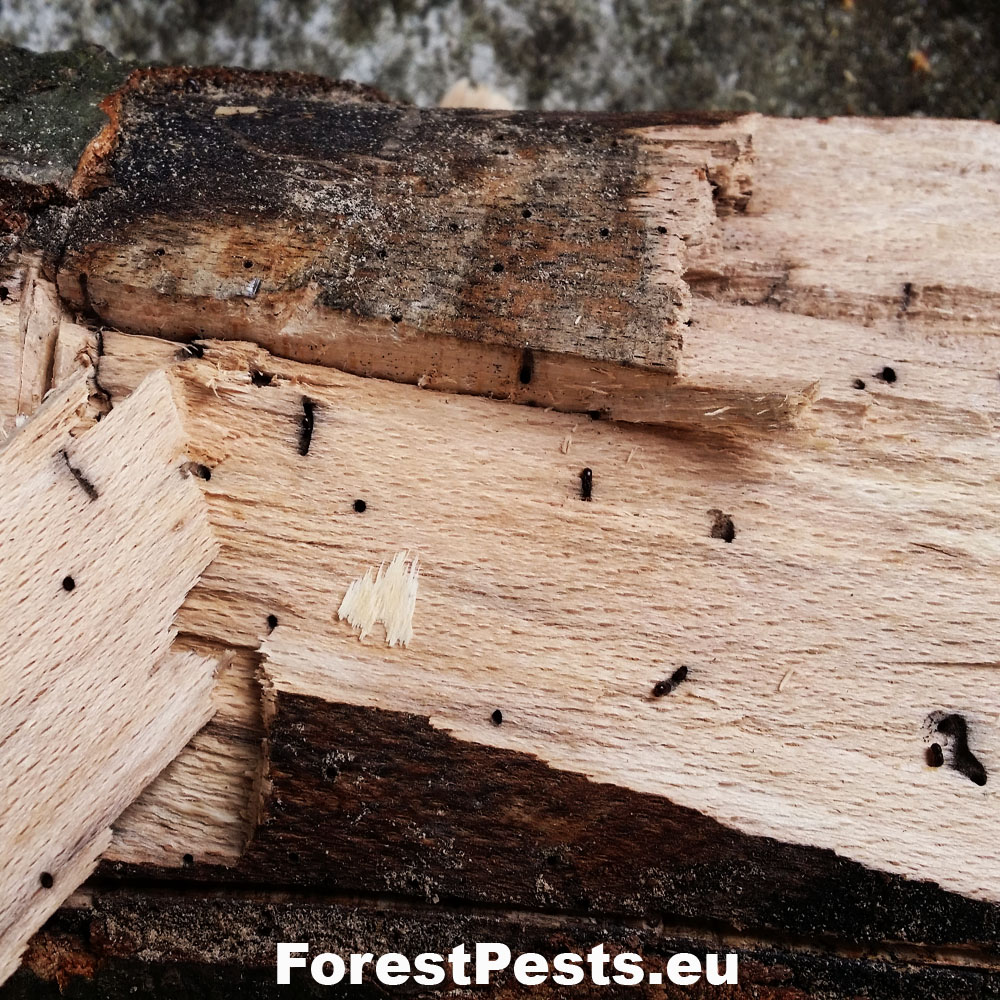
| Black galleries. Foto: J. Galko |
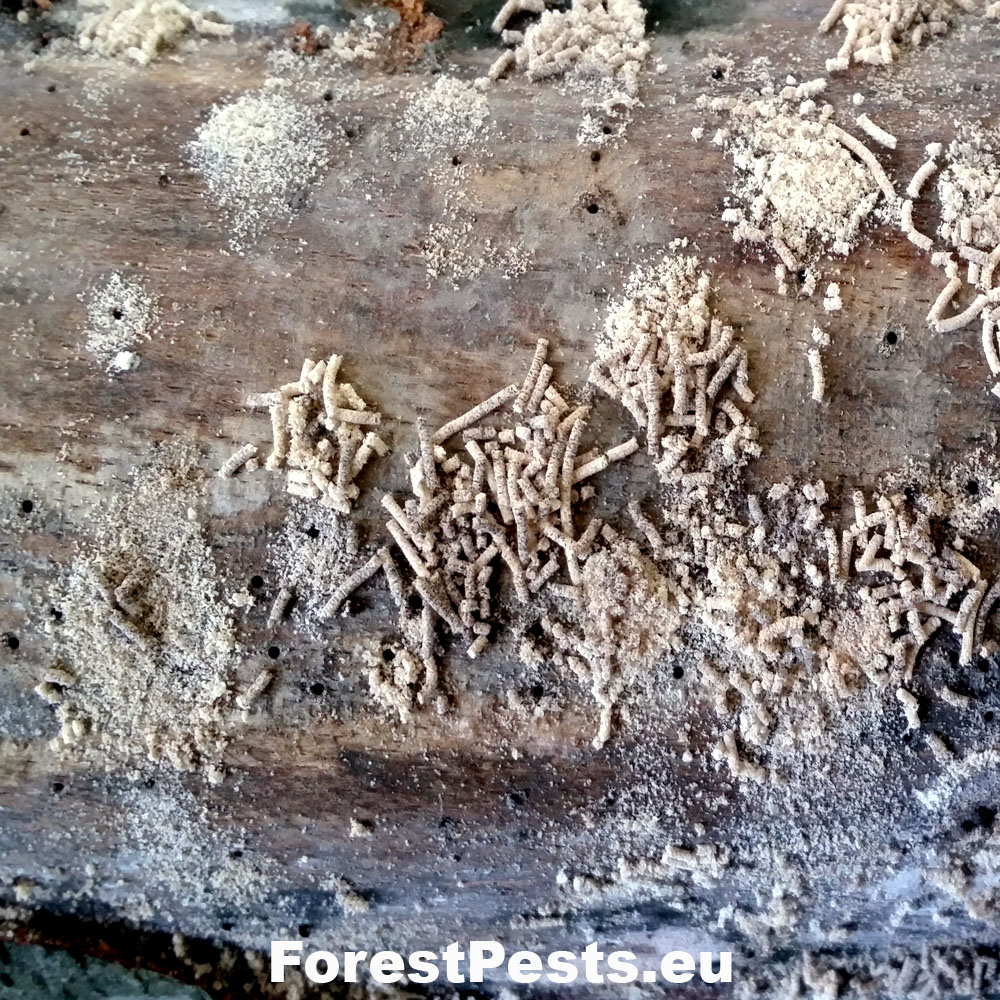
Expelled noodles of sawdust .
Foto: J. Galko
|
Infested debarked wood.
Foto: J. Galko
|
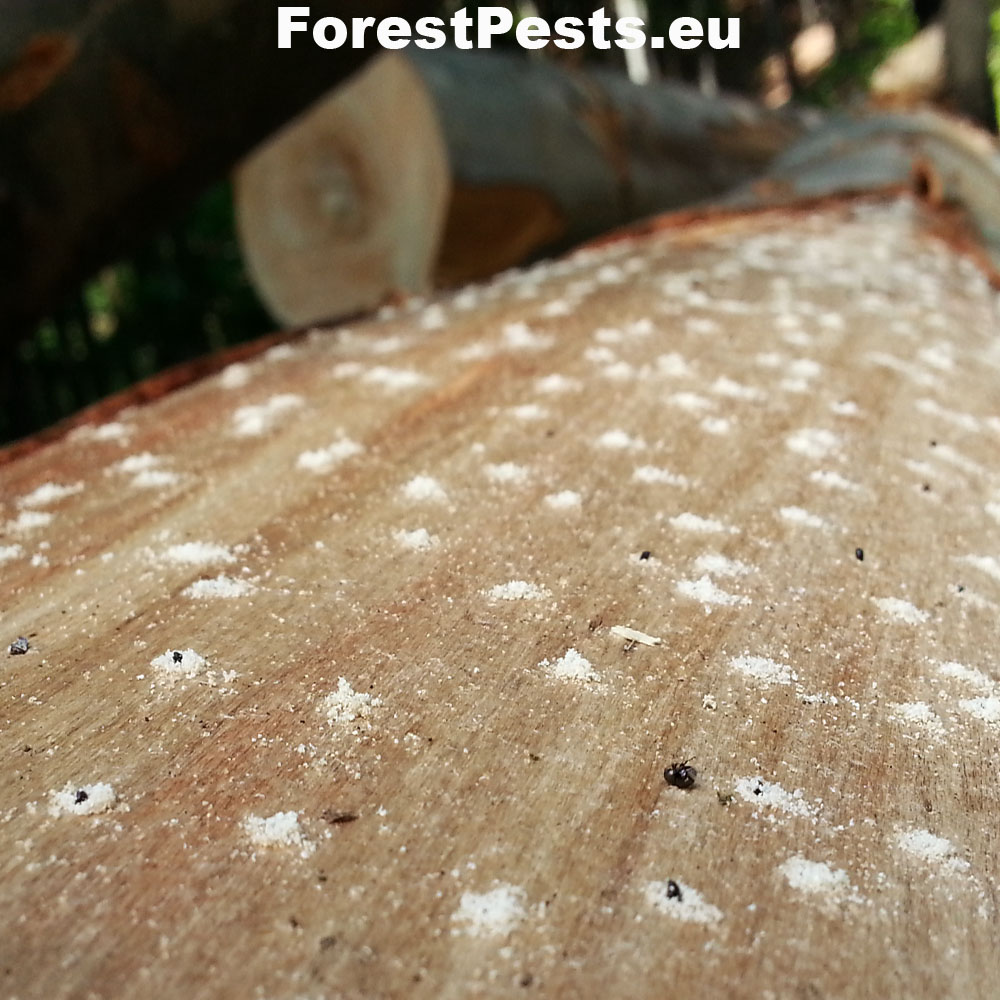
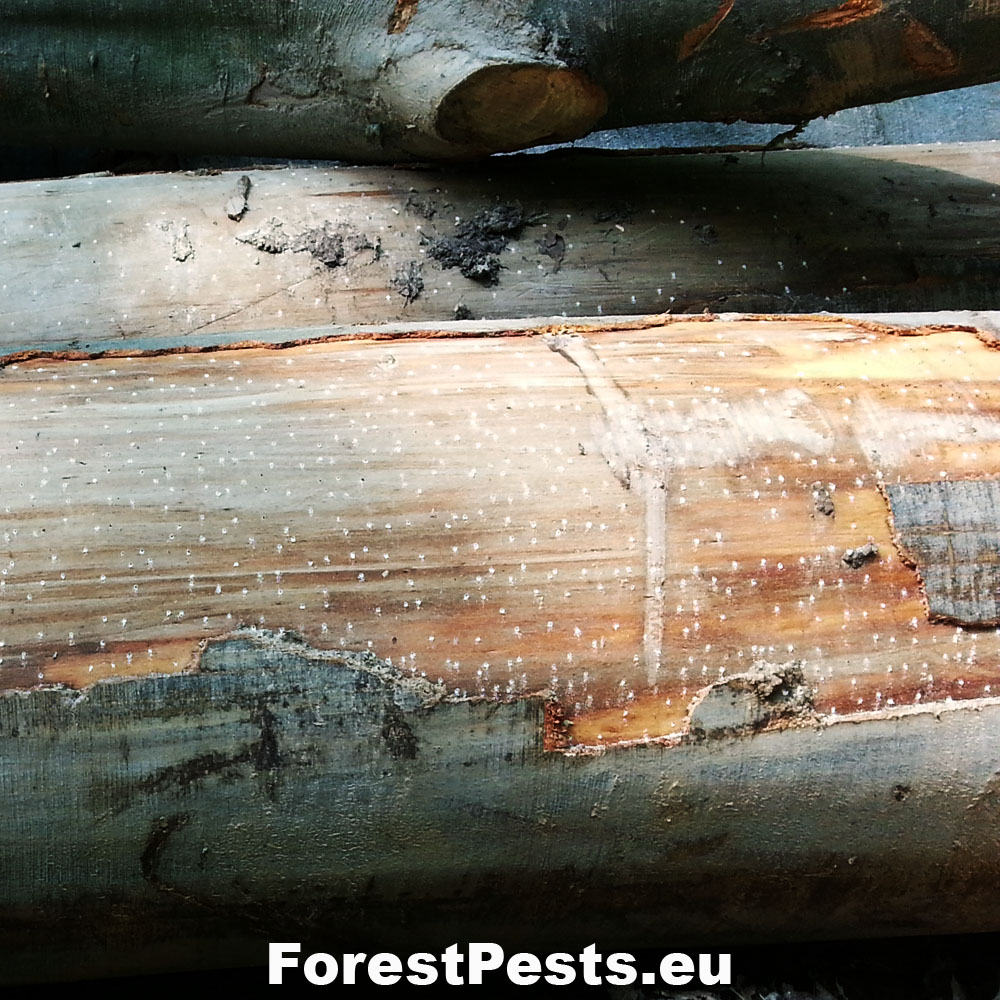
Fresh attacks (white sawdust) on beech timber
Foto: J. Galko
|
Its natural area is in East Asia, from where it has spread to the United States and Europe. It was first discovered in the USA in 1932 in New York, from where it spread rapidly to the surrounding states. It is currently located in approximately 30 states and four provinces of Canada. It is harmful to several shrubs and woody plants species, but especially to the eastern American black walnut (Juglans nigra) and Chinese chestnut (Castanea mollissima). For unknown reasons, the species avoids spreading in tropical areas and prefers a temperate zone.
It was first recorded in Europe in Germany more than 60 years ago, from where it spread to neighboring countries such as Switzerland, France, Austria, Belgium, Poland, Italy, Hungary, the Czech Republic (2009), and subsequently Slovakia in 2010. In most of these countries, it has a status of pest, and it is expected to spread further to suitable locations.
In 2017, approximately 700 insect samples from traps were processed from shipping warehouses (SWs) and the Duchonka research area. The aim was to detect the presence of black timber bark beetle. Furthermore, a whole spectrum of common native ambrosia beetles species was obtained from the samples. Then, the black timber bark beetle occurrence was determined using ethanol traps in the same localities as in 2016. The point was to compare the results from two periods, after mild winter (2015/2016) and cold winter (2016/2017), by the non-destructive method.
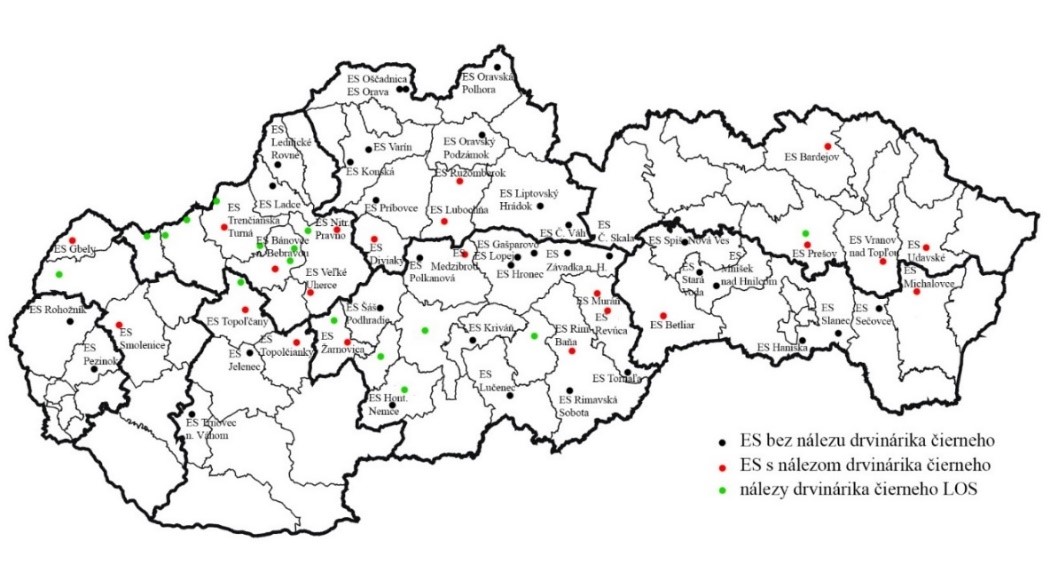
The target species, the black timber bark beetle (Xylosandrus germanus), from the group of ambrosia beetles from captures from the SWs in 2017, represented a 2.7% (3% in 2016) with a total number of 60 captured individuals. The locations of its discovery are shown on the map of its expansion from 2016 and 2017.
Based on these results, we can confirm several new black timber bark beetle occurrences in Slovakia. It was caught at SW Ľubochňa, SW Ružomberok, SW Prešov, SW Bardejov, SW Nitrianske Pravno, SW Veľké Uherce, SW Muráň, SW Revúca, SW Rimavská Baňa, SW Betliar, SW Medzibrod, SW Smolenice, SW Topoľčianky, SW Bánovce nad Bebravou, SW Trenčianska Turná, SW Udavské, SW Vranov nad Topľou, SW Michalovce, SW Gbely, SW Diviaky and SW Žarnovica. In 2016, it was first recorded in eastern Slovakia; this was confirmed in 2017 (SW Michalovce, etc.).
We found the black timber bark beetle in the 21 SWs (in 2016, 15 SWs) from a total of 51 SWs (36%) in both years of monitoring. We also found valuable data on black timber bark beetle distribution while monitoring the double-spined bark beetle. Furthermore, its occurrence was found in several new places in Slovakia. Thus, another significant expansion of this species in Slovakia was confirmed.
The inspectors of the Forest Protection Service found spruce mass infested with black timber bark beetle up to a height of 1000 m above sea level. In the Duchonka research area, the black timber bark beetle was the dominant species caught in traps. In 2017 we captured 2692 individuals, significantly more than the previous year (1951 individuals). Shipping warehouses are excellent places for black timber bark beetle monitoring. There is a material concentration from different tree types, quality, and primary attractants' excretion stages. It may seem that the captured quantities of black timber bark beetle from the SWs are minimal compared to the Duchonka research area. At the SWs, various types of ethanol are also emitted from the wood mass, which confuses the black timber bark beetle female.
Prevention:
Correct timing of valuable assortments storage in risk areas (e.g., winter). At the time of the occurrence of the pest, preventive spraying of valuable assortments with an authorized product.
Monitoring:
The walk checks for the infestation signs. Traps baited by ethanol lures are also suitable for pest control.
Pest control:
If females are already drilled deeper in the wood, chemical defense is ineffective.
Pest category: Wood-destroying insect
Found in Slovakia: Yes
Invasive species: Yes
Similar species:
Of the native species, the most similar is the pear blight beetle (Anisandrus dispar), which is, however, much larger. Similar damage is caused on deciduous trees by the European
Literature:
Bruge H, 1995. Xylosandrus germanus (Blandford, 1894) (Belg. sp. nov.) (Coleoptera Scolytidae). Bulletin et Annales de la Société Royale Belge d’Entomologie, 131:s.249-264.
CABI. 2014. Xylosandrus germanus. W: Invasive Species Compendium. Wallingford, UK:CAB International. www.cabi.org/isc
Carter W, 1973. Insects in relation to plant diseases. New York, USA: John Wiley & Sons, Inc.
Faccoli M, 2000. Bioecologia di coleotteri scolitidi Ips typographus (Linnaeus) e species di recente interesse per la selvicoltura italiana. III contributo. Reperti su specie di scolitidi nuove per il territorio italiano. Bollettino dell’ Istituto di Entomologia ‘Guido Grandi’ della Universita degli Studi di Bologna, 54: s.77-90.
Felt EP, 1932. A new pest in greenhouse grown grape stems. Journal of Economic Entomology, 25:418.
Galko, J., 2013: First record of the ambrosia beetle, Xylosandrus germanus (Blandford, 1894) (Coleoptera: Curculionidae, Scolytinae) in Slovakia. Lesnícky časopis - Forestry Journal, 58(4):279.
Galko, J., Nikolov, Ch., Kimoto, T., Kunca, A., Gubka, A., Vakula, J., Zúbrik, M., Ostrihoň, M., 2014: Attraction of ambrosia beetles to ethanol baited traps in a Slovakian oak forest. Biologia, 69 (10): s.1376-1383.
Haase V, Topp W, Zach P, 1998. Eichen-Totholz im Wirtschaftswald als Lebensraum für xylobionte Insekten. Zeitschrift für Ökologie und Naturschutz, 7: s.137-153.
Holzschuh C, 1993. Erster Nachweis des Schwarzen Nutzholzborkenkäfers (Xylosandrus germanus) in Österreich. Forstschutz Aktuell, (12-13):10.
Katovich S, 2004. Insects attacking black walnut in the Midwestern United States. USDA, Forest Service, General Technical Report, NC-243: s.121-126.
Knížek M, 2009. Faunistic records from the Czech Republic – 272. Coleoptera: Curculionidae: Scolytinae. Klapalekiana 45:22
Maksymov JK, 1987. Erstmaliger Massenbefall des schwarzen Nutzholzborkenkäfer, Xylosandrus germanus Blandf. in der Schweiz. Schweizerische Zeitschrift für Forstwesen, 138: s.215-227.
Mokrzycki T, Hilczczański J, Borowski J, Cieślak R, Mazur A, Miłkowski M, Szołtys H, 2011. Faunistic review of Polish Platypodinae and Scolytinae (Coleoptera: Curcuiolonidae). Polish Journal of Entomology, 80:343-364.
Peer K, Taborsky M, 2005. Outbreeding depression, but no inbreeding depression in haplodiploid ambrosia beetles with regular sib mating. Evolution, 59: s.317-323.
Pennacchio F, Roversi PF, Francardi V, Gatti E, 2003. Xylosandrus crassiusculus (Motschulsky) a bark beetle new to Europe (Coleoptera Scolytidae), Redia 86: s.77-80
Stergulc F, Frigimelica G, Zandigiacomo P, Battisti A, 1999. Gravi deperimenti del noce comune in giovani impianti da legno in Friuli-Venezia Giulia. Sherwood-Foreste ed Alberi Oggi, 5(4): s.27-31.
Takagi K, Kaneko T, 1966. Biology of some scolytid ambrosia beetles attacking tea plants. V. Chromosome numbers and sex determination of the tea root borer, Xyleborus germanus Blanford [sic] (Coleoptera: Scolytidae). Applied Entomology and Zoology, 1: s.29-31.
Weber BC, McPherson JE, 1983, b. World list of host plants of Xylosandrus germanus (Blandford) (Coleoptera: Scolytidae). The Coleopterists Bulletin, 37: s.114-134.
Wood SL, Bright DE, 1992. A Catalog of Scolytidae and Platypodidae (Coleoptera), Part 2: Taxonomic Index Volume A. Great Basin Naturalist Memoirs, 13: s.1-833.
