

Mycosphaerella dearnessii
"Brown spot needle blight" causes a similar disease of the assimilative organs of pine trees as Mycosphaerella pini. The pathogen was introduced to Slovakia in the mid-90s of the 20th century.
Its anamorphic stage is the fungus Lecanostica acicola (Thümen) H. Sydow. However, the sexual stage (teleomorph) of the fungus Mycosphaerella dearnasii Rost. in Munk rarely occurs in our conditions.
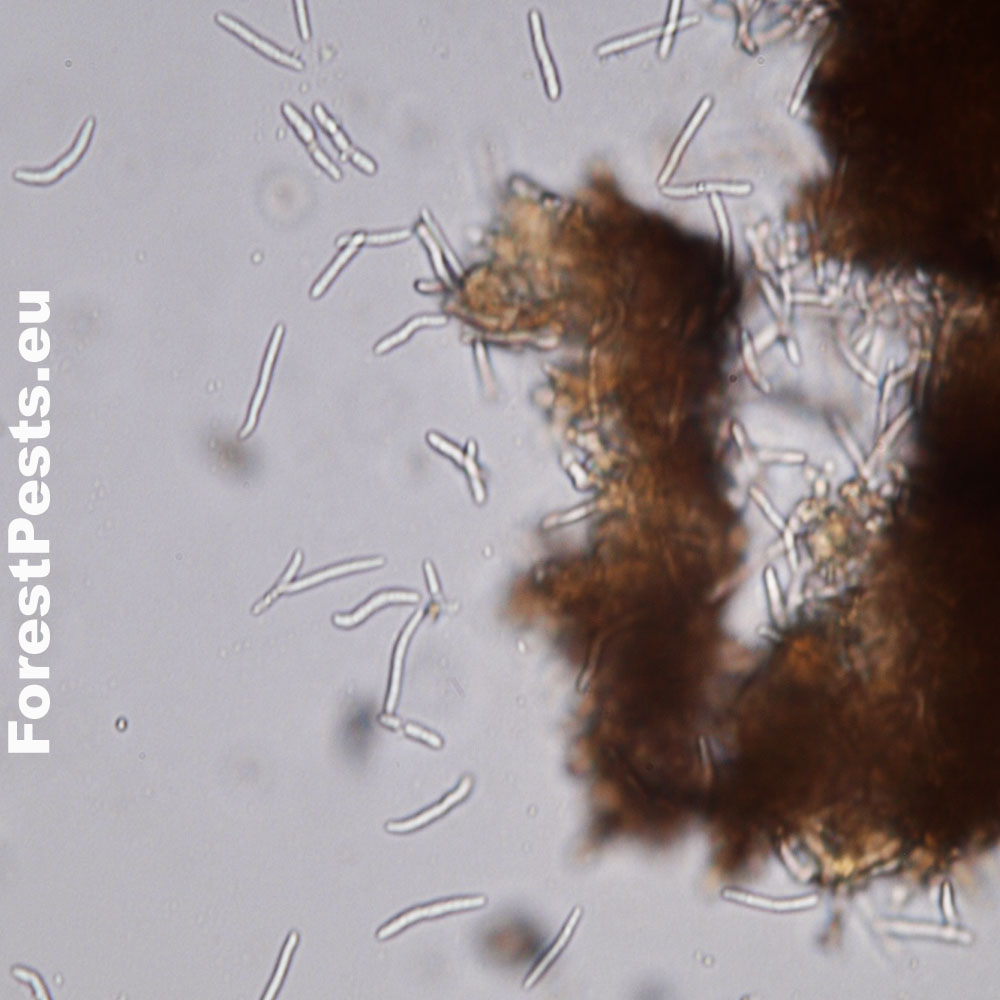
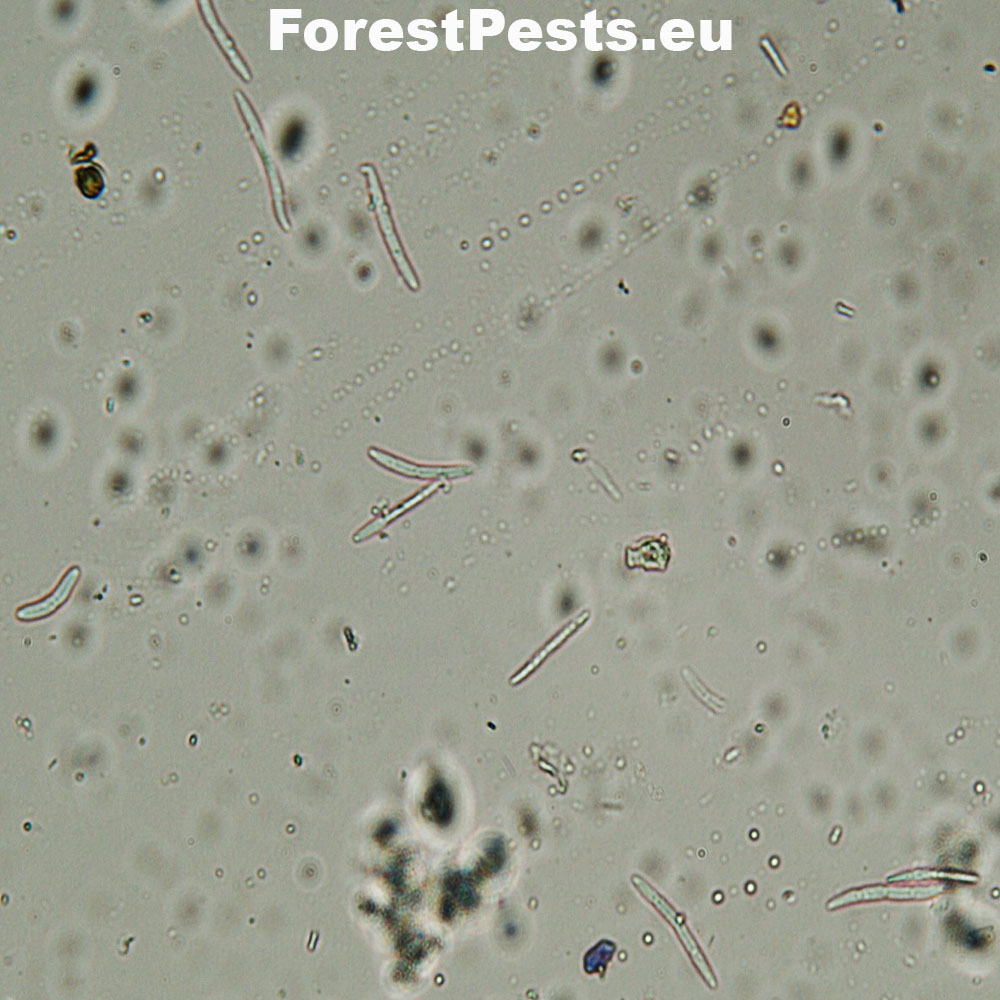
Differentiation of individual brown spot needle blights is possible mainly through conidia. The conidia of M. dearnessii are more stocky, slightly curved, 2 - 4.5 micrometers wide. The surface of the conidia is moderately bumpy. It is a dangerous cause of disease of the assimilative organs of conifers.
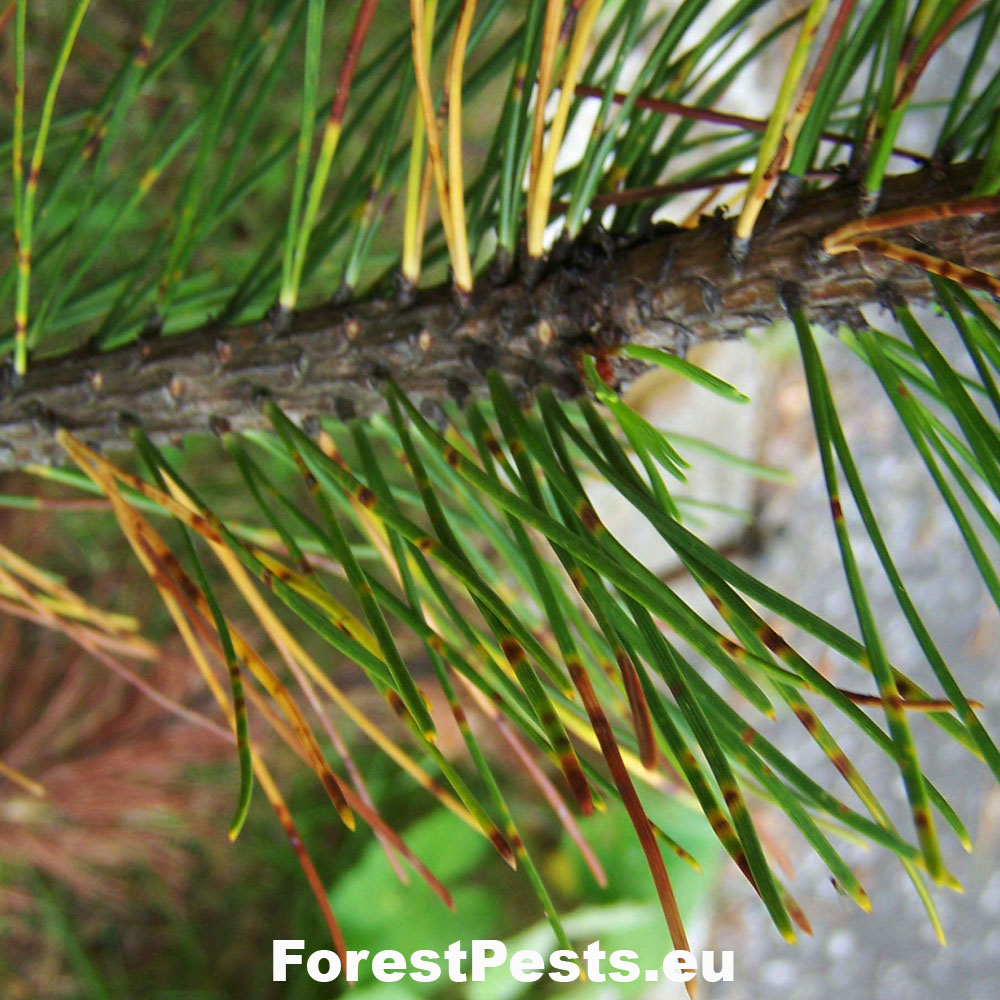
The first symptoms are pale yellow to brown spots, reminiscent of insect wounds. In November, the infected needles are already brown, and by the end of December, brownish-red spots appear on the browned needles up to the transverse stripes (hence the common name).
Pycnids are black lumps that pierce the epidermis and form conidia in the spring. However, the development cycle will not resume until the beginning of next year. After the reproductive formations have overwintered, conidia are released under favorable climatic conditions, mainly sufficient rainfalls and air temperature of 18 to 25 ° C.
Symptom:
 |
 |
 |
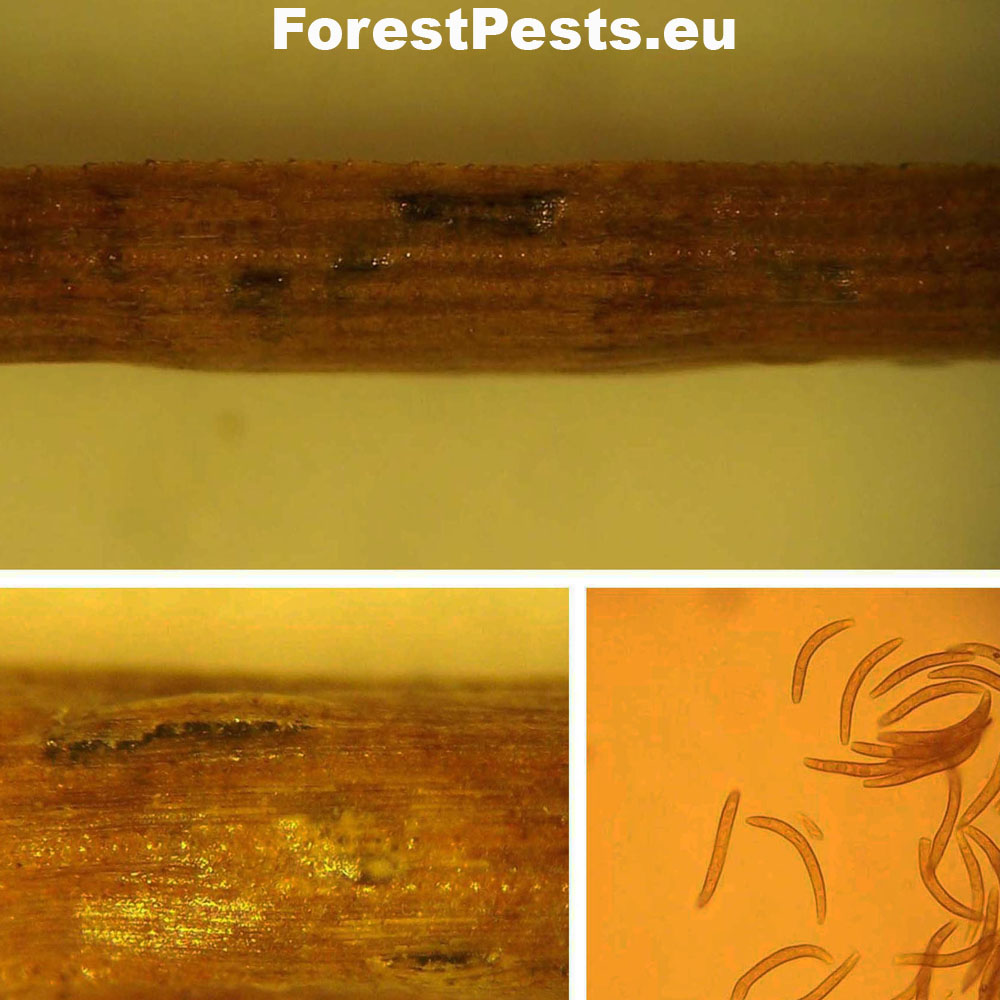 |
| Conidia of the fungus. Photo: Foto: H. Ivanová | Conidia of the fungus. Photo: H. Ivanová |
Infested needles of Scots pine with fungus Lecanosticta acicola in the area Stará Lesná. Photo: K. Pastirčáková |
Detail of infested Scots pine needle and conidia of an anamorphic stage of Lecanosticta acicola. Photo:
K. Pastirčáková
|
Endangered woody plants:
Damaged plant parts: Assimilation organs
The sufficient spacing during planting has to be preserved. Also, the weed in the plantations has to be removed to avoid favorable moisture conditions suitable for the formation of conidia.
Found in Slovakia: Yes
Invasive species: Yes
Similar species:
Some species of genus Lophodermium cause similar symptoms on pines in our conditions. One of the identifying features is a brown band and spots on the needles when infested with the fungus Mycosphaerella dearnessii M. E. Barr.
Bednářová, M., Palovčíková, D., Jankovský, L., 2006: The host spectrum of Dothistroma needle blight Mycosphaerella pini E. Rostrup – new hosts of Dothistroma needle blight observed in the Czech Republic. Journal of Forest Science 52: s. 30–36.
Butin, H., Richter, J., 1983: Dothistroma need le blight: a new pine disease in the FRG.
Nachrichtenblatt des Deutschen Pflanzenschutzdienstes 35, s. 129-131.
Gibson, I.A.S. (1979) Diseases of forest trees widely planted as exotics in the tropics and southern hemisphere. Part II. The genus Pinus. Commonwealth Forestry Institute and Commonwealth Mycological Institute, Oxford and Kew, UK.
Gong, X.D.; Liang, Z.C. (1988) The resistance of slash pine to brown spot needle blight. Journal of South China Agricultural University9, s. 54-59.
IMI (1994).
Chandelier, P., Lai-aurie, C; Maugari,F., 1994: Decouverte en France de Myeospbaerella dearnessii sur Pinus attenuata x radiata. C.R. Acad. Agric. Fr. 80, s. 103-108.
Ivanová, H., Bernadovičová, S., 2010: Druhová diverzita mikroskopických húb borovice čiernej rastúcej v urbanizovanom prostredí Nitry. In: Juhásová, G., Adamčíková, K., Kobza, M., Ondrušková, E. (eds.): Dreviny vo verejnej zeleni 2010 : Recenzovaný zborník z konferencie s medzinárodnou účasťou, 22. - 23. 6. 2010 Banská Bystrica. Nitra, Ústav ekológie lesa SAV, Pobočka biológie drevín Nitra. 2010, s. 80-87. ISBN 978-80-89408-08-5.
Jankovský, L., Palovčíková, D., 2000: Karanténní sypavky Mycosphaerella pini E. Rostrup a M. dearnessii M.E. Barr v České republice. Lesnická práce. 79, (8), p. s. 370 – 372.
Jankovský, L., Palovčíková, D., 2003: Chrádnutí borovice černé na Moravě a ve Slezku. Lesnická práce, 82,(3), p. s. 24 – 26.
Jankovský, L., Palovčíková, D., Tomšovský, M., 2009: Brown spot nedele blight associated with Mycosphaerella dearnessi occurs on Pinus rotundata ina the Czech Republic. Plant Pathology, 2, p. s. 398.
Kais, A.G., 1971: Dispersal of Scirrhia acicola spores in southern Mississippi. Plant Disease
Reporter 55, s. 309-311.
Kais, A., Cordell, C., Affeltranger, C., 1986: Benomyl root treatment controls brown-spot disease on longleaf pine in the southern United States. Forest Science 32, s. 506-511.
Kapitola, P., Růžička, T., Kroutil, P., 2011: Karanténní škodlivé organismy na lesních dřevinách. Státní rostlinolékažská správa Praha. 63 pp.
Karadzić, D., 1989: Scirrhia pini. Life cycle of the fungus in plantations of Pinus nigra in Serbia. European Journal of Forest Pathology 19: s. 231–236.
Kunca, A., Foffová, E., 2000: Ohrozenie porastov borovice čiernej fytokaranténnym patogénom Dothistroma septopora (Dorog). Morelet. In: Aktuálne problémy v ochrane lesa 2000, zborník z referátov z celoslovenského seminára, 17.–18. apríla 2000 v Banskej Štiavnici, Zvolen, LVÚ Zvolen, s. 136–139.
La Porta N, Capretti P, 2000: Mycosphaerella dearnessii, a needle-cast pathogen on mountain pine (Pinus mugo) in Italy. Plant Disease, 84. p. s. 922.
Petrak, F., 1961: Die Lecanosticta Krankheit der Föhren in Österreich. Sydowia 15: s. 252–256.
Zúbrik, M., Kunca, A., Turčani, M., Vakula, J., Leontovyč, R., 2006: Invasive and quarantine pests in forests in Slovakia. OEPP/EPPO Bulletin 36: s. 402–408.
