

Lymantria dispar -
The gypsy moth (Lymantria dispar L.) is a moth in the Erebidae family. It is widespread throughout Europe (excluding the Nordic countries) and North Africa and extends across Asia to eastern China and Japan. Around 1869, it was accidentally introduced to the United States near Boston. The intention to import the gypsy moth into the USA was to cross extremely vital individuals with the domestic silkmoth, widely bred in America for silk production. A new, very resistant species were obtained by crossing these two species, ensuring silk production at a lower cost. However, the gypsy moth escaped from the laboratories and has since been established. As a result, it began to spread and cause catastrophic damages (Scheld, 1936, Doane, McManus, 1981, McManus, Csoka, 2007).
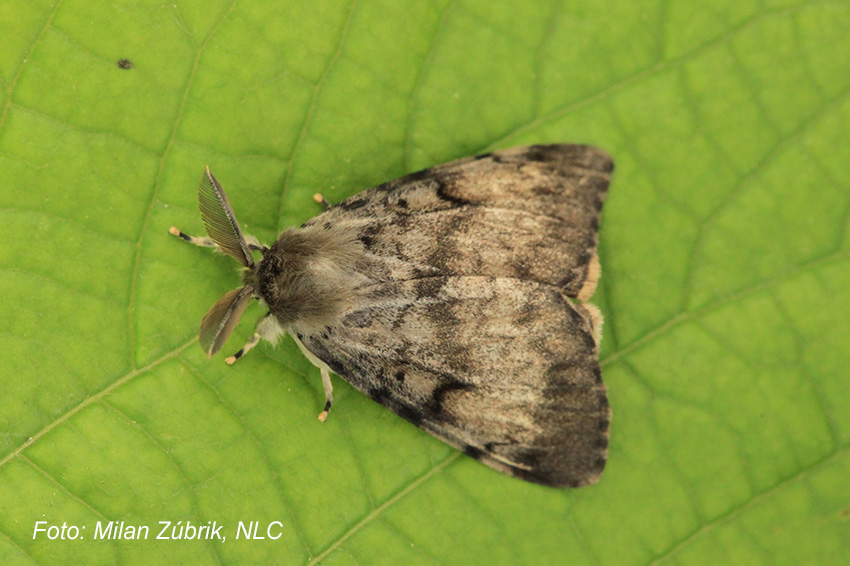
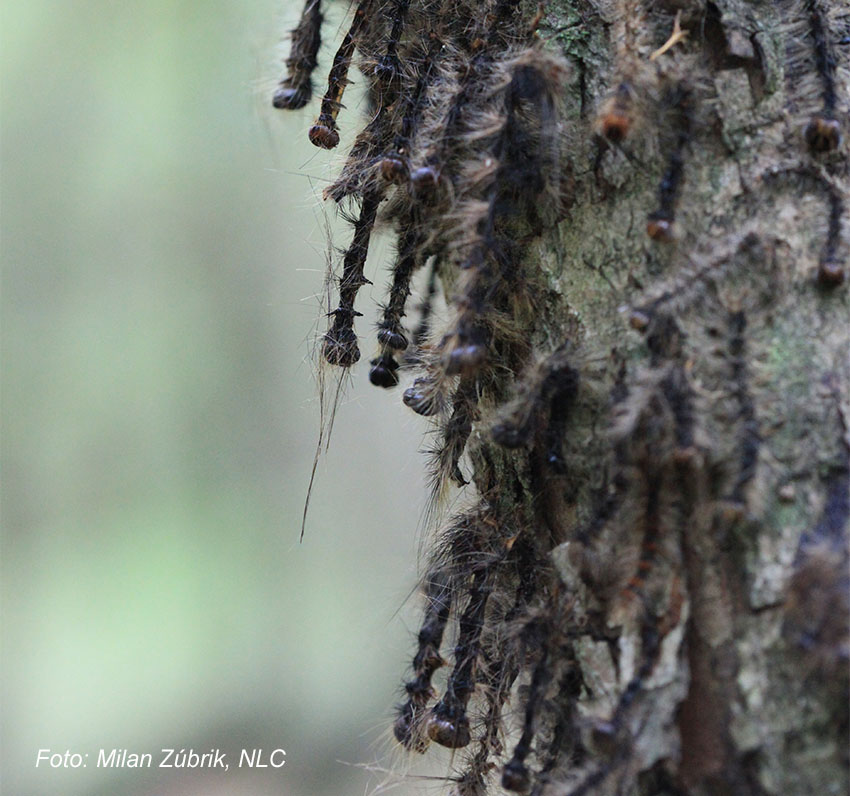
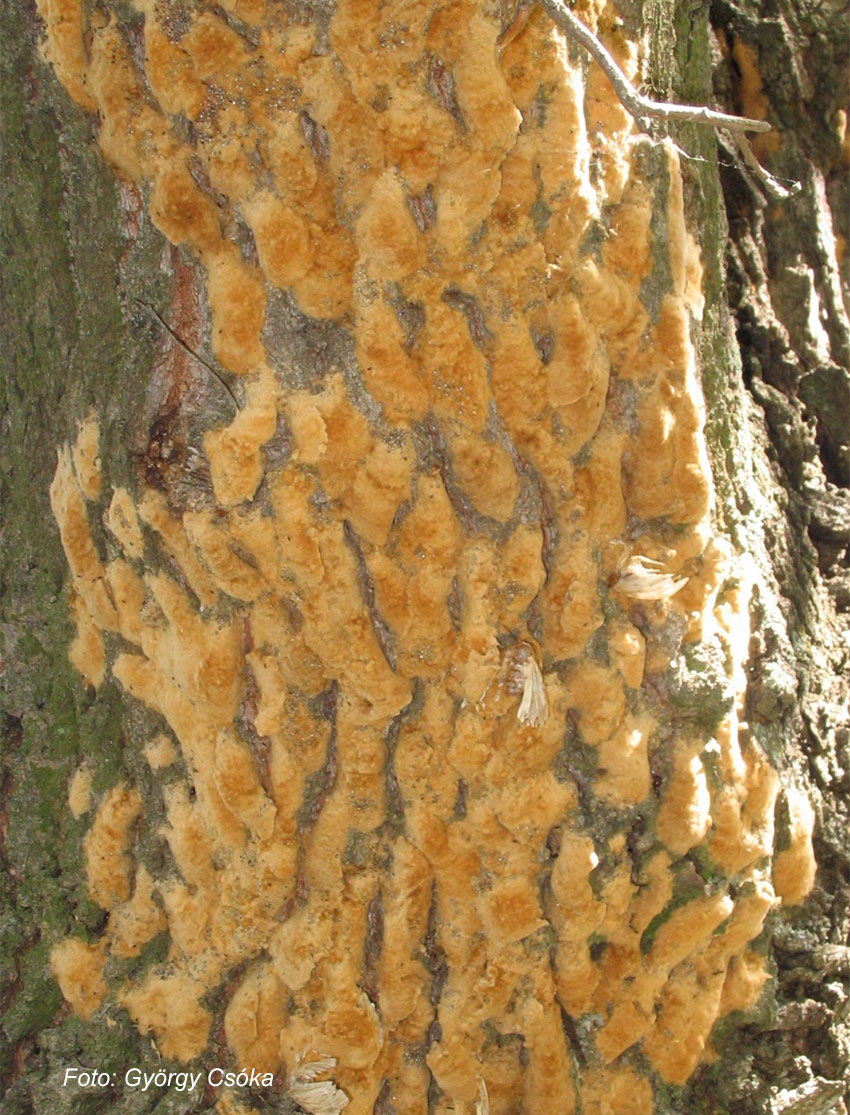
Moths hatch in July. After mating, the female lays 500-1000 eggs on the masses on the tree trunk. The gypsy moth hibernates in egg masses covered with tan or buff-colored hairs. The eggs hatch into caterpillars in the spring when oak sprouts in mid-April. They are 4-5 cm large, gray-blue-yellow, covered with hair-like setae with a row of red nipples and a yellow, black-marbled head. They feed on leaves for about 40-60 days and pupae on the trunk, leaves, or undergrowth (Scheld, 1936, Doane, McManus, 1981, Zúbrik et al., 2013, 22/2019, 7/2019).
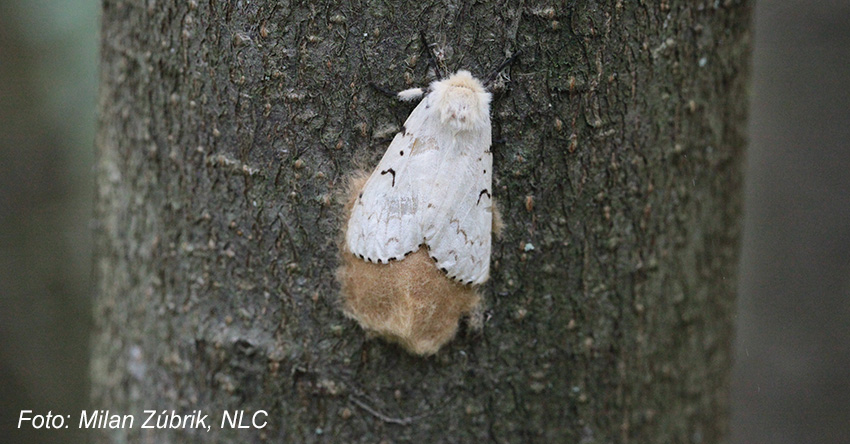
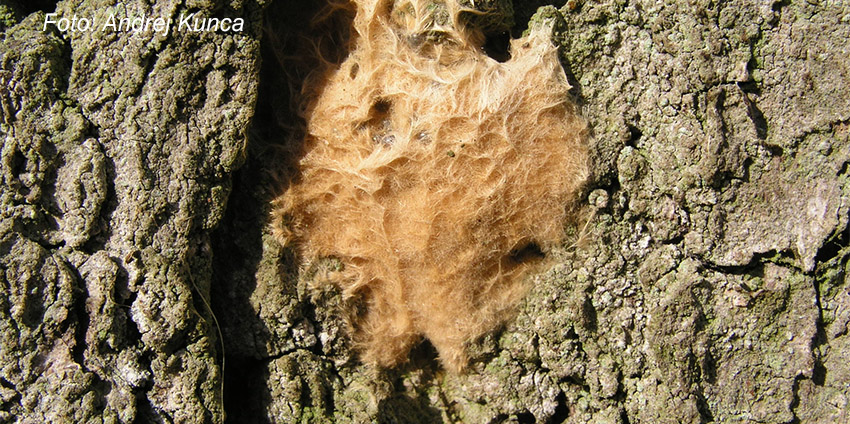
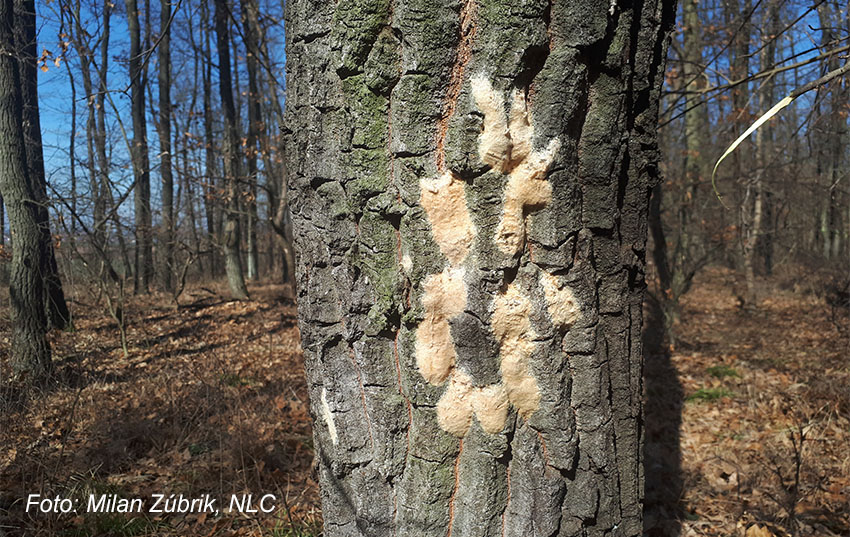
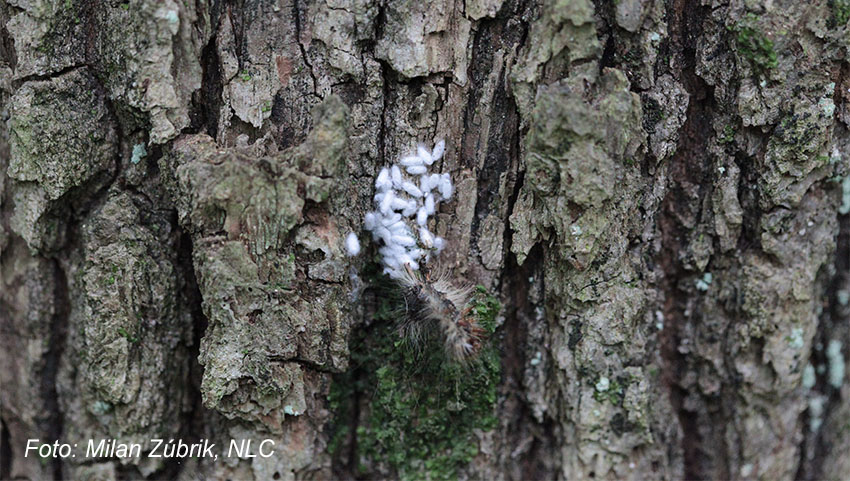
During the gradation, there are often several egg masses on one trunk. There are 500 - 1000 eggs in the egg mass. Females also deposit eggs on branches in tree crowns (Photo: Milan Zúbrik).
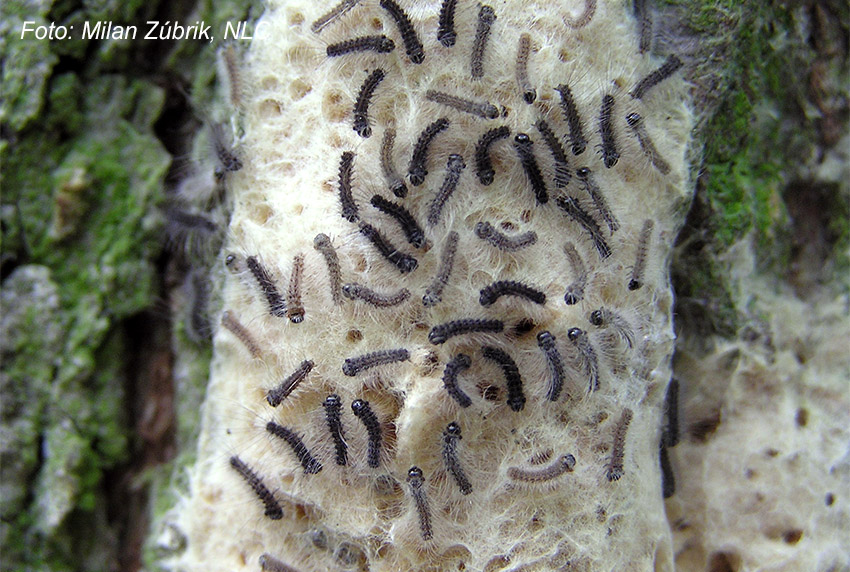
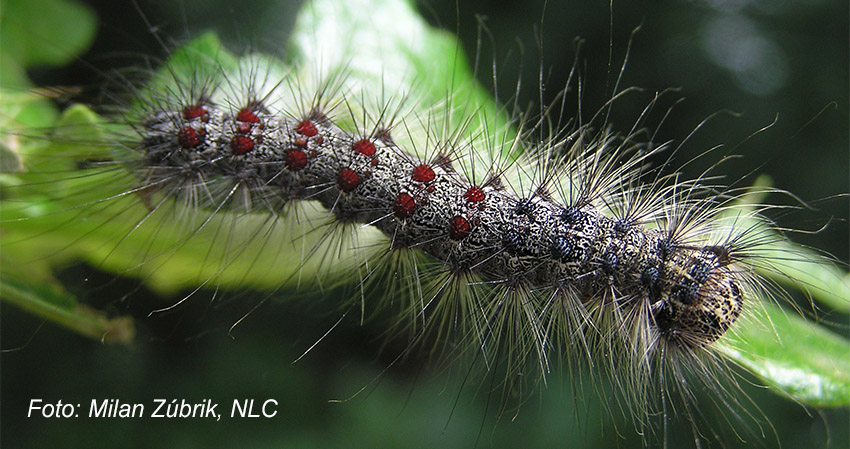
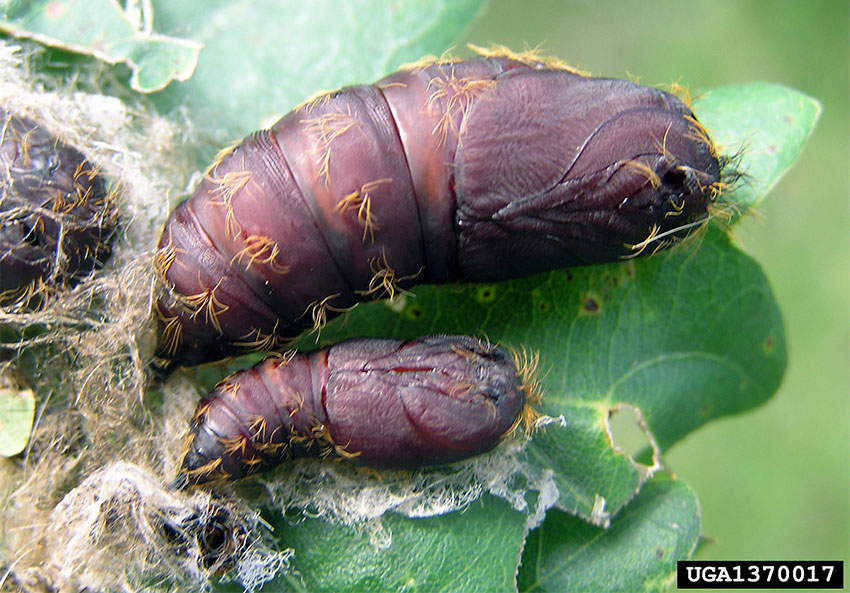
The caterpillars are polyphagous - they consume the leaves of various deciduous trees. They prefer scattered Turkey oak stands, but other woody plants such as pedunculate and sessile oak, poplar, hornbeam, beech, cherry, apple, and maple are also highly suitable hosts. During caterpillar outbreaks, they also consume conifers such as spruce, pine, or larch and may even damage adjacent agricultural fields or orchards (Scheld, 1936, Kurir, 1953, Leontovych, 1980, Doane, McManus, 1981, Stolina, 1985, Novotný 1986, Surovec, 1989, McManus, Csoka, 2007, 23/20109).
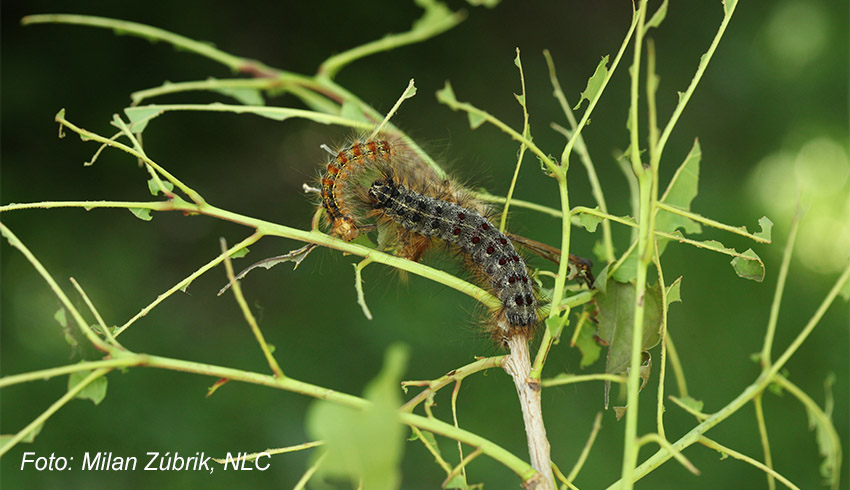
Caterpillars live on deciduous trees, especially oak (Photo: Milan Zúbrik).
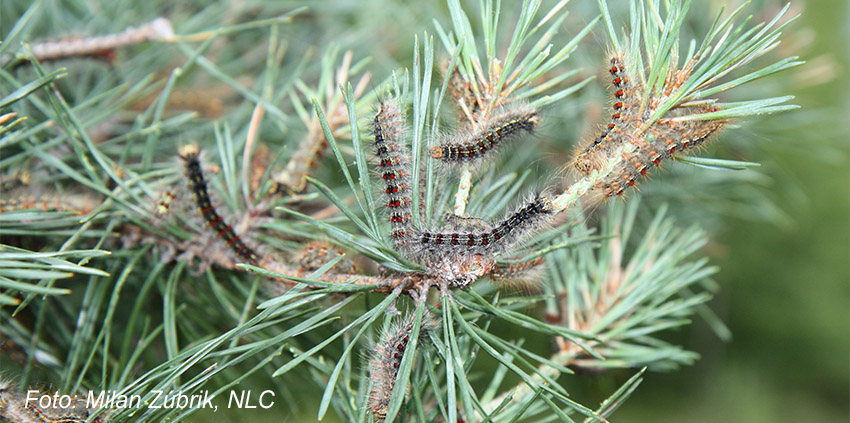
In case of lack of food, caterpillars also eat conifers, grass, crops, fruit trees, etc. The picture shows the caterpillars of a gypsy moth on pine needles in the surroundings of town Levice (Slovakia) during the gradation in 2005 (Photo: Milan Zúbrik).
Gradation
The gypsy moth female is genetically programmed to produce a large number of vital offspring approximately every 7-9 years (Doane, McManus, 1981, Turčáni et al. 1997, Pernek et al. 2008, Hlásny et al., 2015, Zúbrik et al., 2016). In 2 years, the number of moths will increase several thousand times - gradation. Gradations occur at irregular intervals because, in addition to genetics, they are also influenced by other factors, such as weather, natural enemies, etc. (Patočka, 1967, Doane, McManus, 1981, McManus, Csoka, 2007). Why an outbreak occurs is still not fully understood.
During the larval stage, a single caterpillar can eat an average of one square meter of leaves (6/2019). One egg mass consists of approximately a thousand eggs from which the same amount of caterpillars will hatch. By the time they mature, they will consume about 1000 m2 of leaves, which is an area of about 30 x 30 m. It is enough caterpillars to consume a large part of the leaves on a single tree during the spring. However, there can be up to 250 egg masses on one tree (Patočka 1973) !!
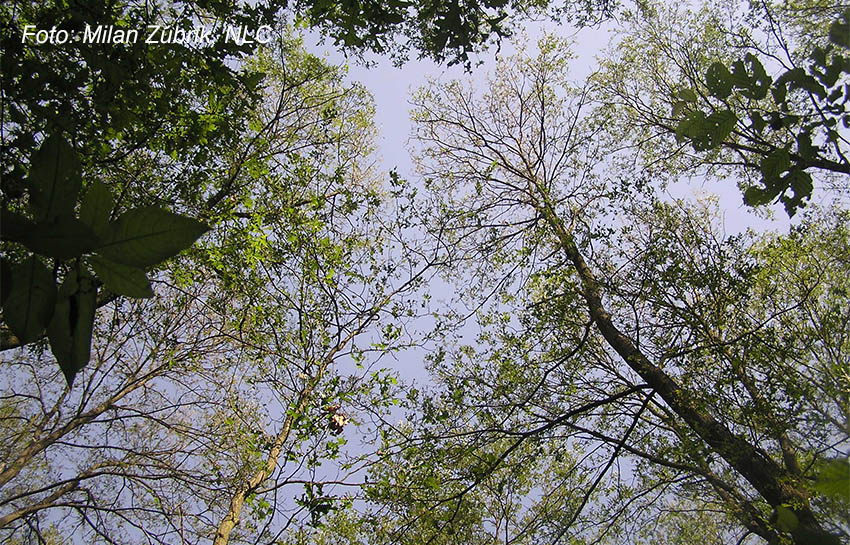

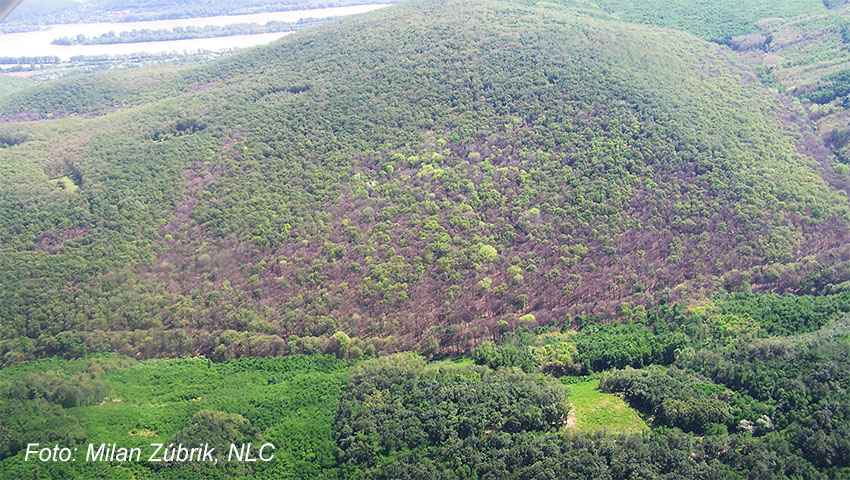
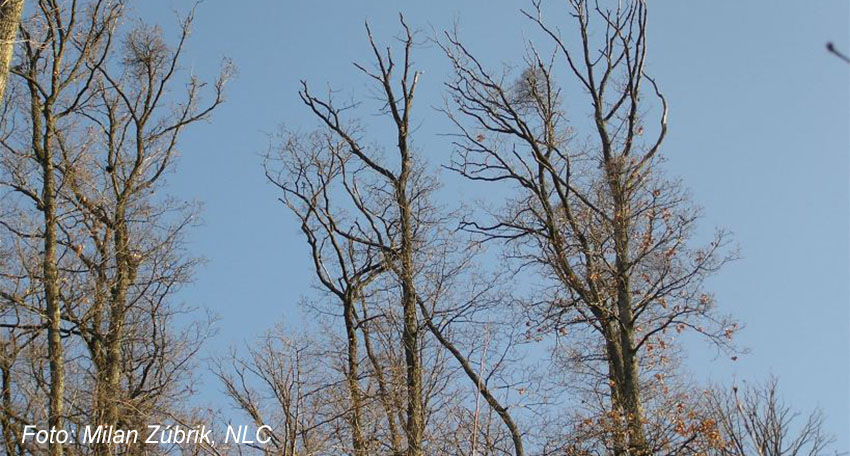
- The gypsy moth damages trees by eating their leaves when the tree needs them most - in the spring when it generates energy for its growth. Thus, trees lose 50-70% of their annual growth during the year.
- Because the tree loses its leaves, it cannot form the stock reserve. On the contrary, it must mobilize its stocks and use them to develop new leaves, re-created in late June and early July. As a result, it produces stress and makes the tree more sensitive to other pests such as insects or fungi. A stressed tree gradually dies if it is still exposed to dry and warm weather.
- If a deciduous tree is healthy, it usually survives one year of gypsy moth gradation because it has enough energy to form new leaves. However, repeated outbreaks over several years may cause a deciduous tree to die.
- Conifers can die after just one defoliation.
- Defoliation reduces seed crop.
- Young, planted trees usually do not survive a one-year insect feeding.
- If gardens and orchards are infested, crop damage occurs.
Potential economic loss associated with gypsy moth on forest?
Oak forests are intended to produce a valuable, renewable raw material - oak wood. Oakwood is highly valued in the furniture and wood-processing industry. The oak wood price ranges from 100 to 600 euros, with an average of 200 euros per 1 m3.
With the loss of 50-70% of the annual increment (the annual increment is about 5 m3 by 100% oak composition and total stand density at the age of 40-100 years) and with the trees death of 1-10% after the calamity of the gypsy moth in the stand (Patočka, 1961, Davidson and 1999, 2/2019), the economic damage per 1 ha of the oak forest will easily reach the amount of 2-3 000 euros. If 1000 ha of high-quality oak stands were defoliated, the damage could be 2-3 mil. Euro.

The peripheries of villages and towns adjacent to the forest, where the gypsy moth have reproduced, often experience the invasion of caterpillars in gardens, orchards, children's playgrounds, parks, or courtyards.
The caterpillars of the gypsy moth pose a hazard to human health. Their fragile hairs break easily and cause severe allergic reactions and subsequent breathing problems when pierced into the skin. Individuals with allergies may have stronger reactions. Similarly, but even more harmful in this respect are related species of the gypsy moth, such as Thaumetopoea processionea, T. pityocampa, or Euproctis chrysorrhoea (Aber et al. 1982, Tuthil et al. 1984, Zúbrik et al., 2013).
There are several natural enemies of the gypsy moth. After 2-3 years of outbreak, usually, natural enemies and lack of food will cause mass mortality of caterpillars, and their reduction - nature will deal with calamity (Doane, McManus, 1981, Fuester a kol. 1983, Patočka a kol. 1999, McManus, Csoka, 2007, Zúbrik a kol. 2014, 2016, 2018)
-
The main natural enemies include parasitic sabre wasp, braconid wasp, etc.
-
Entomopathogenic organisms, such as the fungus Entomophaga maimaiga, microsporidia, viruses, or bacteria, also play an essential role.
-
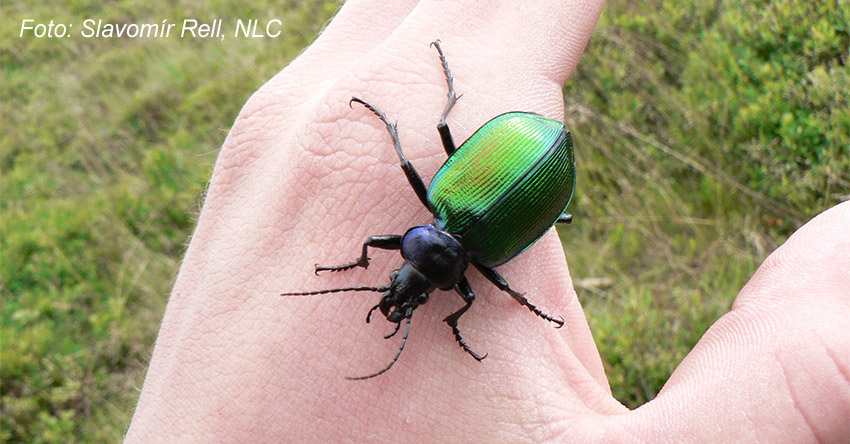
Some beetle species, such as Calosoma sycophanta, eat caterpillars.
-
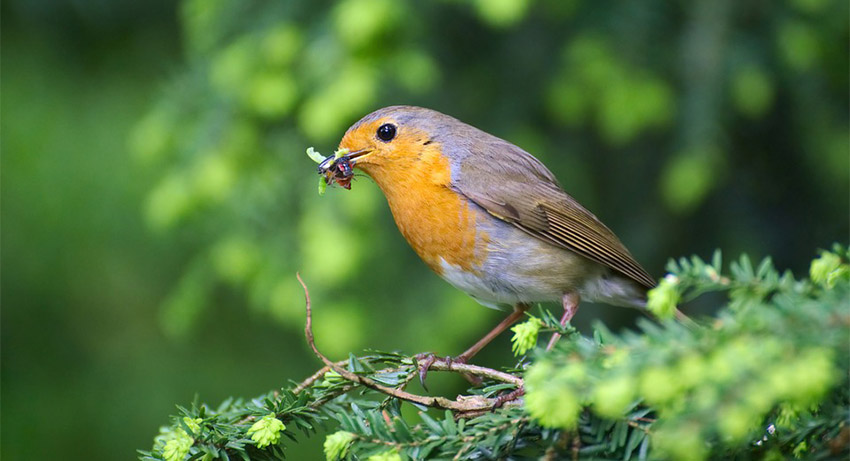
Small songbirds feed on eggs in the winter, but they do not feed on the large, hairy caterpillars of the gypsy moth.
-
Rodents mainly eat pupae.
At the end of the 19th century, the eggs of the gypsy moth were scraped off from the trees by hand (Scheld, 1936, Doane, McManus, 1981). In the 1950s and 1960s, they were coated with DDT, old oil or diesel (Turček et al., 1950, Patočka 1961). However, this practice is not common in forests anymore; due to the vast number of eggs, it is impossible to find and destroy them (Doane, McManus, 1981).
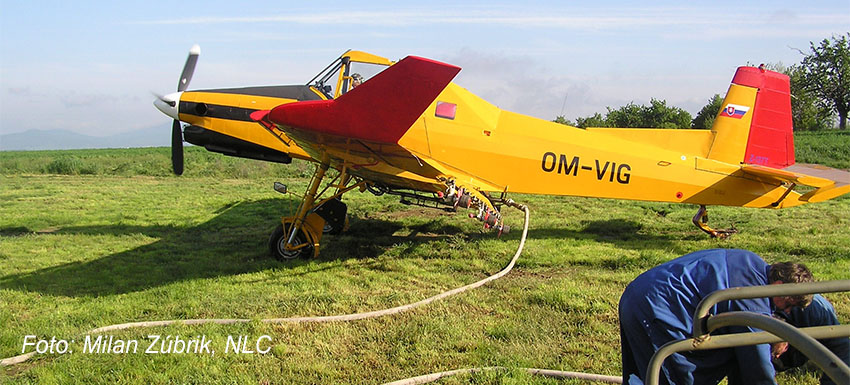
These days, aerial applications of biological preparations based on strains of bacteria (Bacillus thuringiensis), viruses (NPV), or other biological substances, are used against caterpillars in the USA and Europe (Doane, McManus, 1981, McManus, Csoka, 2007, Zúbrik 2006). Above mentioned preparations are not harmful to other non-target organisms, do not leave residues, and do not induce resistance. It is so far the most effective way to eliminate caterpillars in forests, parks, gardens, or human dwellings (Doane, McManus, 1981, McManus, Csoka, 2007, Zúbrik and Kovalčík 2005, Zúbrik 2006). The implemented measures are estimated to have helped save almost $ 4 billion in 25 years in the USA (McManus, Csoka, 200).
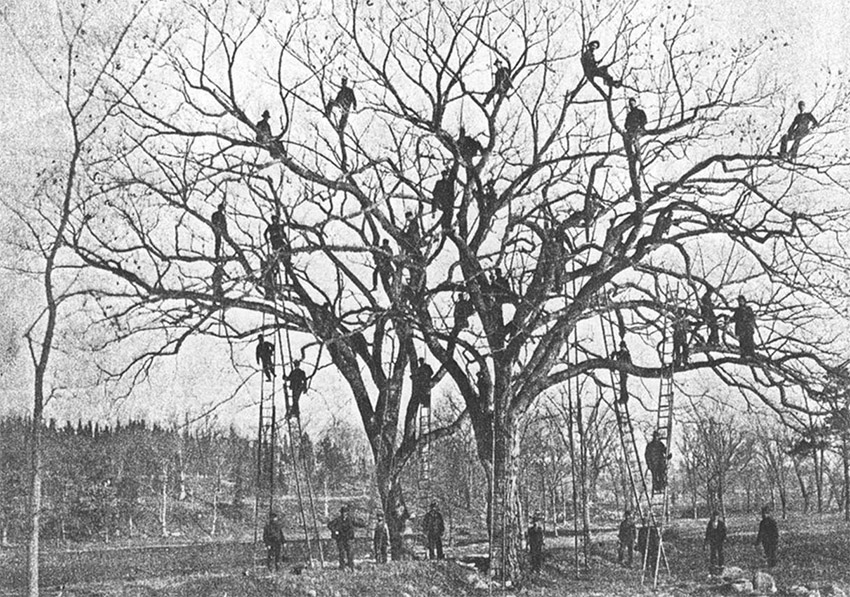
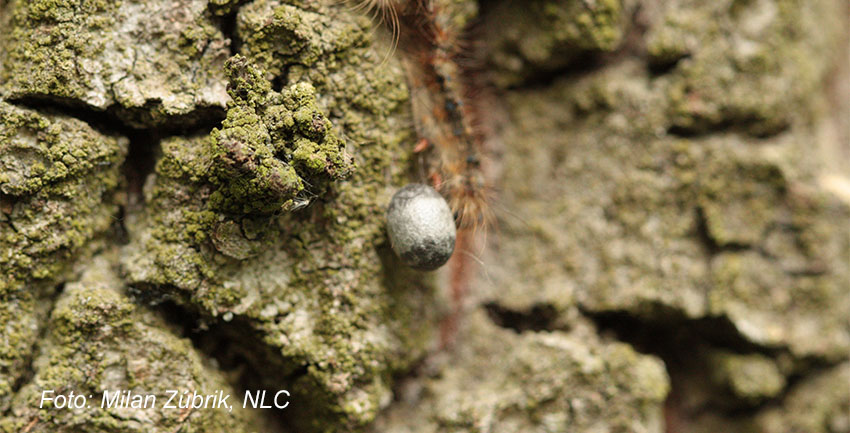
Scratching eggs from trees (around 1900) did not bring the desired effect. During outbreak, females not only lay eggs on tree trunks, but also place them on thin twigs in the crown. It is impossible to find all the egg masses on the tree. (Photo: https://www.mass.gov/guides/gypsy-moth-in-massachusetts).
- Aber R, DeMelli T, Gill T, Healey B, McCarthy MA, Osell N: 1982: Rash illness associated with gypsy moth caterpillars. MMWR 1982; 31:169-170.
- Cenník dreva. https://www.lesy.sk/files/lesy/www-stranky-oz/trencin/cennik-sortimentov-suroveho-dreva-platny-od-1-1-2018_.pdf.
- Davidson C.B., Gottschalk K.W. & Johnson J.E. 1999: Tree mortality following defoliation by the European gypsy moth (Lymantria dispar L.) in the United States: a review. — Forest Sci. 45: 74–84
- Doane, C., McManus, M. L. (ed) 1981: The gypsy moth: Research toward integrated pest management. USDA For. Serv. Sci. Educ. Ag. Technical Bull. 1584, Washington, D. C. 1981, 757s.
- Fuester, R. W., Drea, J. J., Gruber, F., Hozer, H., Mercadier, G. 1983: Larval Parasites and Other Natural Enemies of Lymantria dispar (Lepidoptera: Lymantriidae) in Burgenland, Austria, and Wurzburg, Germany. Env. Entomol. 12: 724-737.
- Gypsy moth history. https://www2.illinois.gov/sites/agr/Insects/Pests/Pages/gypsy-moth.aspx
- Gypsy Moth In North America. https://www.fs.fed.us/ne/morgantown/4557/gmoth/. 5. 3. 2019
- Hlásny T, Trombik J, Holuša J, Lukášová K, Grendár M, Turčáni M, Zúbrik M, Tabaković-Tošić M, Hirka A, Buksha I, Modlinger R, Kacprzyk M, Csóka G, 2015: Multi-decade patterns of gypsy moth fluctuations in the Carpathian Mountains and options for outbreak forecasting. J Pest Sci, doi: 1007/s10340-015-0694-7.
- Kurir, A. 1953: The food plant of the gypsy moth (a contribution to the knowledge of its feeding habits). Z. Angew. Entomologie. 34: 543-586.
- Leontovyč, R., a kol., 1980: Hlavné škodlivé činitele v lesoch Slovenskej socialistickej republiky. Lesnícke štúdie 32, Príroda, Bratislava, 94 pp. ISBN 64-021-80.
- McManus M., Csóka G., 2007: History and impact of gypsy moth in North America and comparison to the recent outbreaks in Europe.- Acta Silvatica et Lignaria Hungarica, 3: 47-64
- Novotný, J. 1986: Nový charakter kalamity mníšky ve¾kohlavej (Lymantria dispar) v lesoch Slovenska. Zprávy les. vysk. 31(3): 26-29.
- Patočka, J., 1967: O príčinách vzniku a zániku gradácií mníšky veľkohlavej (Lymantria dispar L.) v Európe. In: IV. vedecká konferencia VÚLH, časť 1. Zvolen. 1967 - sborník. Zvolen VÚLH 1967: Z-I/1 - 7.
- Patočka, J., 1973: Kalamita mníšky veľkohlavej na území Lesnej správy Levice. - Les, 29, 1973, s. 446 - 448
- Patočka, J., Krištín, A., Kulfan, J., Zach, P., 1999: Die Eichenschadlinge und ihre Feinde. Zvolen: vyd. SAV, Zvolen, 396 s.
- Pernek M, Pilas I, Vrbek B, Benko M, Hrasovec B, Milkovic J., 2008: Forecasting the impact of the gypsy moth on lowland hardwood forests by analyzing the cyclical pattern of population and climate data series. For Ecol Manag 255:1740–1748
- Schedl, E. 1936: Der Schwammspinner in Euroasien, Afrika und Neuengland. Berlin, Verlagsbuchhandlung Paul Parey, 242 s.
- Stolina, M. a kol., 1985: Ochrana lesa. Vydavateľstvo príroda. Bratislava. 480 s.
- Surovec, D., 1989: Hlavné škodlivé činitele v lesoch SSR za roky 1975 – 1986. Lesnícke štúdie 45, Príroda, Bratislava, 122 pp. ISBN 80-07-00095-X
- Turcek, F. - Ppatocka, J. - Pasek, V.: Letecke poprasovanie s DDT(gesarol) proti bekyni velkohlavej (Lymantria dispar) na Slovensku. Polana, 6, 1950, c. 1, s. 8-10
- Turčáni M., Zúbrik, M., 1997: Defoliation of forest stands by leaf-eating insect in Slovakia during period 1972-1996. In.: Knížek, M., Zahradník, P., Diviš, K., (ed): Proceedings Workshop on Forest Insects and Disease Survey, Písek. s. 142-144.
- Tuthill RW, Canada AT, Wilcock K, Etkind PH, O’Dell TM, Shama SK. 1984: An epidemiologic study of gypsy moth rash. Am J Public Health. 74:799–803.
- University of Illinois Extension: gypsy moth. https://extension.illinois.edu/gypsymoth/ 3. 2019
- Zúbrik M, Barta M, Pilarska D, Goertz D, Uradnik M, Galko J, Vakula J, Gubka A, Rell S, Kunca A , 2014: First record of Entomophaga maimaiga in Slovakia. Short communication. Biocontrol Science and Technology. doi:10.1080/09583157.2014.883362
- Zúbrik M, Hajek A, Pilarska D, Špilda I, Georgiev G, Hrašovec B, Hirka A, Goertz D, Hoch G, Barta M, 2016: The potential for Entomophaga maimaiga to regulate gypsy moth Lymantria dispar (L.) (Lepidoptera: Erebidae) in Europe. J Appl Entomol. doi:10.1111 / jen.12295
- Zúbrik, M., 2006: Mníška veľkohlavá v 3. roku – záver gradácie a prognóza vývoja v nasledujúcich rokoch. In: Aktuálne problémy v ochrane lesa 2006. Zvolen, NLC 2006, s. 109 – 114.
- Zúbrik, M., Kovalčík, J., 2005: Kalamita mníšky veľkohlavej, stav, predpoklad vývoja a realizácia obranných opatrení. In.: Zborník referátov - Aktuálne problémy v ochrane lesa 2005. s. 117-122.
- Zúbrik, M., Kunca A., Csoka, G. (eds) 2013: Insects and Diseases damaging trees and shrubs of Europe. Napedition, Paris, ISBN: 9782913688186, 535 p.
- Zúbrik, M., Špilda, I., Pilarska, D, Hajek, A.E., Takov, D., Nikolov, C., Kunca, A., Pajtík, J., Lukášová, K., Holuša, J. 2018: Distribution of the entomopathogenic fungus Entomophaga maimaiga (Entomophthorales: Entomophthoraceae) at the northern edge of its range in Europe. Annals of Applied Biology. doi:10.1111/aab.12431.
