

Requests to determine the cause of damage
Here you can request to determine the cause of the damage. You can view the requests of other users and sort them according to the selected criteria. In addition, you can get information about your request, and you can follow the progress of its current state. If your application was not approved, it had probably been because it was impossible to identify the damage based on the sent photos or because the application does not address our topic - determining the pests of trees and shrubs. We will inform you about the status of your application by email.
Rejected requests are not displayed. You have been notified by email that your application has been denied.

From: gio
Assigned: V. Longauerová
Country: Italy
Question
Answer
Dear Gio, thank you for your request and picture.
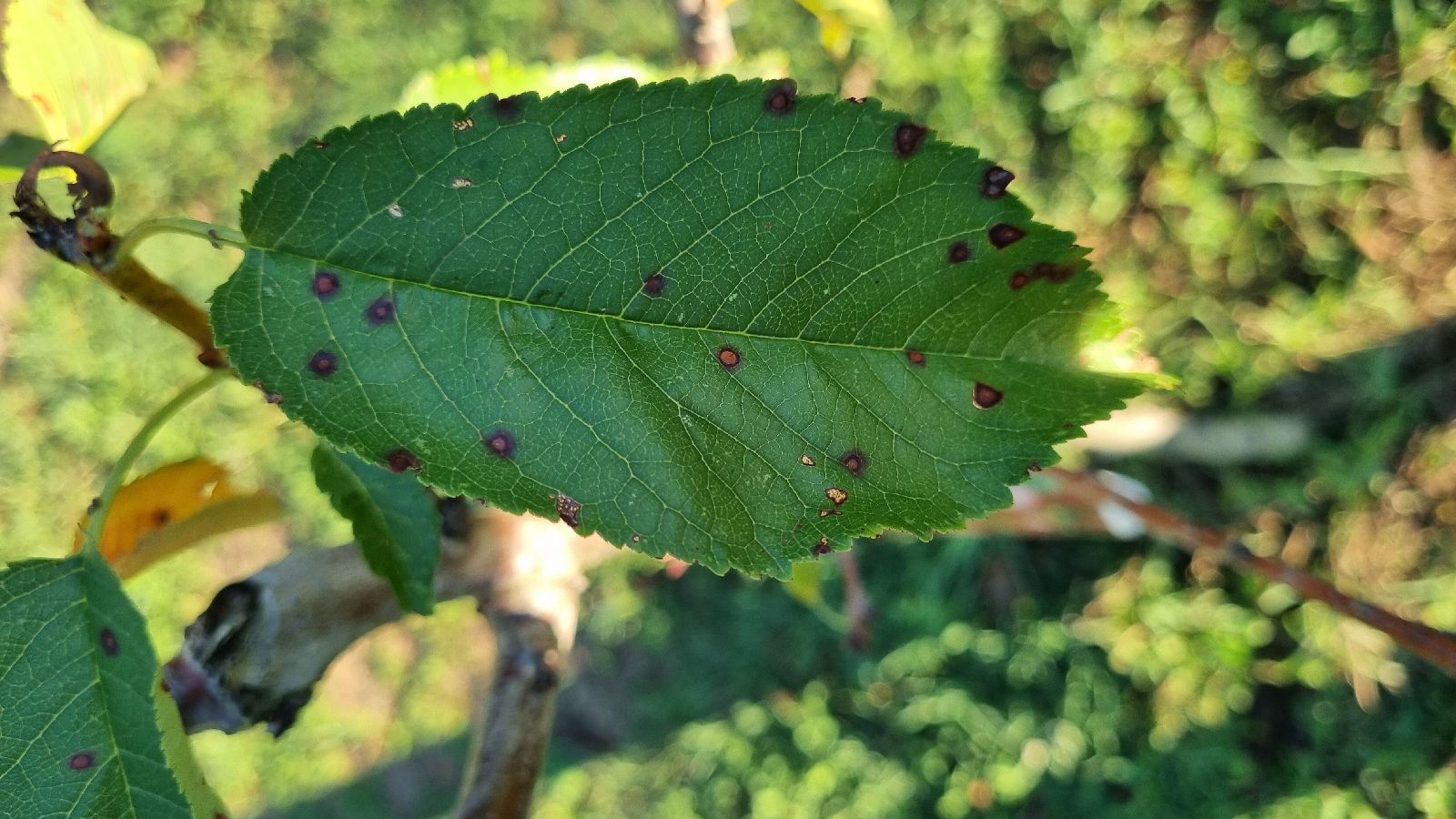
Cherry leaf spot (Blumeriella jaapii) is an important disease in Europe and America. Bird cherry (Prunus avium) causes the greatest damage. Other host plants include cherry (Prunus cerasus), common apricot (Prunus armeniaca) and common peach (Prunus persica). The pathogen mainly attacks the leaf blades, but exceptionally it can also attack the stems and fruits.
Symptoms and harmfulnessParadoxically, unlike many other pathogens, cherry leaf spot primarily attacks older leaves. On the upper side of the leaf blade, distinctly red round spots of 1-2 mm in size are formed. On the underside of the leaf blade, smaller, sharply demarcated reddish-brown to dark brown spots are formed. They are covered with a fine coating of conidia. The spots on the lower and upper side of the leaf blade gradually become necrotic. The leaves gradually turn yellow, deform and subsequently fall.
When fruits are attacked, significantly darker, sharply demarcated spots appear on the fruits. Infested fruits are usually deformed.
The damage consists in the premature fall of the leaves, which reduces the photosynthetic activity of the tree. Trees have weaker growth, they are susceptible to environmental stress factors such as winter frosts or significant periods of drought. The pathogen results in a qualitative and, in particular, a quantitative reduction of the harvest. Spotting causes a huge problem in fruit nurseries or young plantings, where it slows growth and delays the fruiting period.
Development cycleThe pathogen overwinters on fallen leaves, from which the infection spreads in the spring in the form of ascospores. Ascospores are able to infect leaves, stems and fruits in the period of 3-4 weeks after flowering of cherries. The leaves are infected through the stomata and the first symptoms can be observed 2 weeks after infection. Depending on the weather, they are released into the environment for 4-5 weeks.
In addition to ascospore infection, conidia are the source of primary and secondary infection in many cases. Wet and rainy weather significantly promotes infection pressure. Infection can only occur if the leaf is wet. In the case of temperature, the optimum conditions for germination are in the range of 15-25 °C.
ProtectionThe basis of protection is, first of all, the selection of habitat, variety, and cultivation form. It is important to avoid cold and damp locations, where the conditions for the development of mottledness are optimal. Ensuring an airy and non-compacted crown is important from the point of view of shortening the time of wetness of the leaves and thus preventing the germination of ascospores and conidia. Similar to the case of apple scab, it is also advisable to dispose of the fallen leaves and thereby significantly reduce the infection pressure in the following growing season.
In the case of optimal weather conditions for the spread of the pathogen, it is advisable to carry out protection with fungicidal preparations 3-4 weeks after flowering. Preparations that contain the active substances mancozeb, fluopyram+trebuconazole, boscalid+paraclostrobin, dithianone have proven to be suitable. This treatment should be repeated after 10 days. If there is a long dry period during this period, there is no need to apply fungicides.
With best regards,
Valeria
Number of votes for this answer: 0
Pest
Cherry leaf spot
Blumeriella jaapii

