


Ips duplicatus
The double-spined bark beetle is a 2.8 - 4.5 mm long beetle. The wing covers are dark brown and cylindrical; the depressing back part of the wing covers is shiny; four pairs of spines are on the sides. The upper one is further away from the others. The distance between the first and second spine is 2 to 2.5 times greater than between the second and third, which form the so-called double-spine. The males' largest third spine is widened in the upper part; the female has no enlarged third pair. The intersections on the wing covers are slightly dotted. The antenna has bent seams.
The egg is oval, shiny, white, 0.7 mm long in diameter.
The larva is legless, whitish, with a brown, strongly chitinized head; in the last instar, it grows to a length of 4.5 - 5.5 mm. The pupa is unattached, about 5 mm long, white, with two short spikes at the end of the anus.
The body's shape most closely corresponds to the European spruce bark beetle, from which it differs by about a third smaller in size. However, the small spruce bark beetle can also be confused, which is the same size but is darker and narrower, with a more elongated body shape.
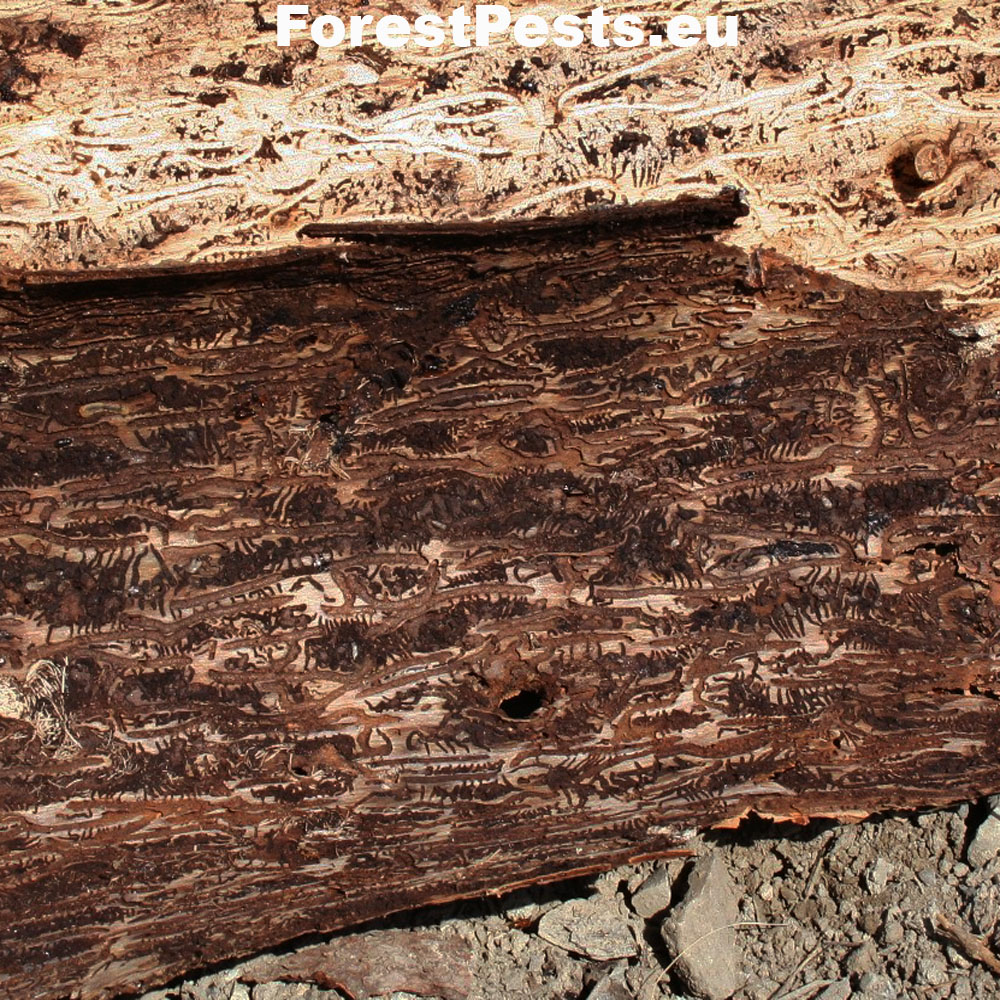
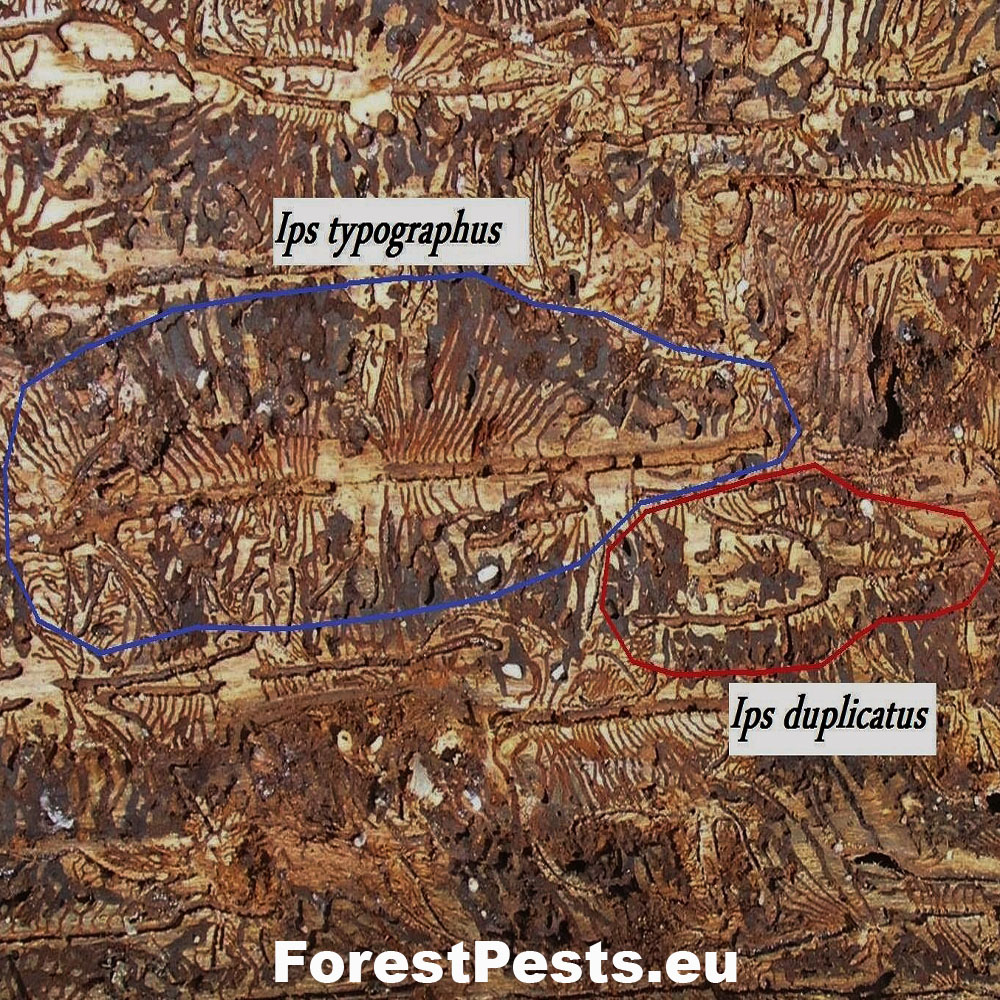
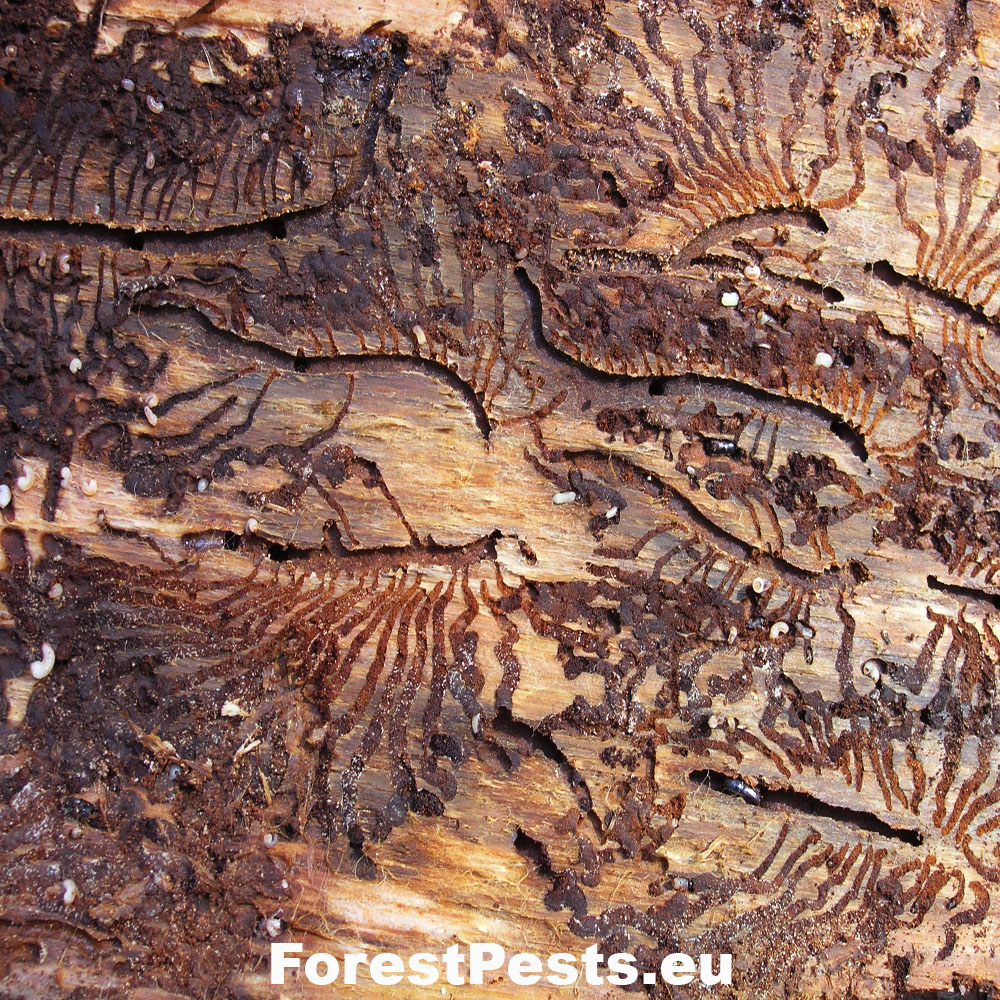
The galleries can be one to five armed, but usually two to three armed. The maternal galleries are 4 - 7 cm (max. 13 cm) long, about 2 mm wide, not straight. The larvae galleries are short, a maximum of 5 cm. In the infested part of the trunk, the galleries of the double-spined bark beetle are often mixed with the galleries of the six-toothed spruce bark beetle, European spruce bark beetle, or the small spruce bark beetle. The galleries of I. duplicatus are similar to those of the six-toothed spruce bark beetle, European spruce bark beetle, or the small spruce bark beetle. The galleries are most similar to the galleries of the European spruce bark beetle, compared to which its maternal galleries are a little shorter and about one-third narrower. When the double-spined bark beetle galleries have three maternal galleries, these resemble the letter Y, the adjacent galleries heading more to the sides, in contrast to the European spruce bark beetle galleries, which have two side galleries almost parallel straight.
 |
 |
 |
 |
|
Galleries on spruce. Photo: J.Vakula
|
Galleries of double-spined bark beetle and European spruce bark beetle.
Photo: J.Vakula
|
Galleries on spruce. Photo: J.Vakula
|
Second and third spine on the rear side of the elytra form the so-called double-spine. Photo: J.Vakula
|
Damaged plant parts: Trunk
Significance: Very significant
Origin and distribution:
Its natural range extends from northern Europe to Kamchatka through Siberia and Yakutia. However, until the beginning of the 20th century, it was rarely described in Central Europe, in the mountain spruce area in the Alps and the Romanian Carpathians.
The double-spined bark beetle gradually expanded with artificial spruce monocultures to the south; it was first described in the early 20th century in northern Poland. Subsequently, it began to spread further into non-native spruce lowlands.
In 1996, for the first time, the double-spined bark beetle was caught in a trap in Zvolen. Also, based on the occurrence of this species in the surrounding countries, all-Slovakia detailed monitoring was carried out in 1997. As a result, the double-spined bark beetle was found in many traps in northwestern Slovakia.
The double-spined bark beetle is commonly found in the spruces of the Žilina and Trenčín regions. In 2008, the highest captures in Slovakia were recorded; more than 10,000 beetles per trap were caught in the districts of Kysucké Nové Mesto, Žilina, and Bytča. Since 2010, increased captures have also been recorded in the districts of Ružomberok, Banská Bystrica, Žiar nad Hronom, Prievidza, and Brezno.
Endangered stands and areas:
Its highest occurrence is recorded in the spruces of northwestern Slovakia. It prefers positions up to 800 m above sea level. It is very often found in the islet-like spruces of the agrarian landscape; it is rarer in long bounded valleys.
Occurrence control:
Double-spined bark beetle is checked visually or by pheromone traps in stands older than 40 years, with at least 20% spruce representation. In case of outbreaks also in younger stands. The occurrence should be checked not only on stand edges, as is by the European spruce bark beetle, but especially inside the vegetation. Whereas it attacks the upper parts of the trunks, it is challenging to find frass on the tree's base, scattered to the surroundings. As a result, the crown discoloration appears late, usually when the beetles are already leaving the infested tree.
Defense is problematic and consists mainly of a quick and consistent search for infested trees and their immediate sanitation. The sanitation methods are the same as for the European spruce bark beetle. The finding of infected trees is problematic. The double-spined bark beetle often attacks trees inside the stand, making it difficult to identify them.
Specific pheromone evaporators (ID Ecolure) can be used for pest control. The installation distance of pheromone traps from the stand edge is 20 m to 40 m. Trap trees and poisoned trap trees are not used against the double-spined bark beetle, except standing trap trees lured by a pheromone evaporator. For standing trap trees, it is better to choose thinner individuals (d1.3 to 30 cm) to be girdled. The pheromone is hung up to a height of 2 m. When checking the infestation on a trap tree, check the surrounding trees must be checked. The degree of the infestation - the number of holes per 1 dm2 - is evaluated according to the scale used for the European spruce bark beetle (on 20 dm2 of continuous surface in the densest occupied part of the trunk). During the severe infestations of trap trees, it is necessary to strengthen defensive measures and use other trap trees or traps. As with traps, the proper positioning of the trap trees is essential. Its final efficiency depends on that to a large extent.
Pest category: Insects - bark beetles
Invasive species: Yes
Similar species: European spruce bark beetle (Ips typographus), small spruce bark beetle (Ips amitinus)
Literature:
Bakke, A., 1975: Aggregation pheromone in the bark beetle Ips duplicatus (SAHLBERG). Norw. J. Ent. 22, s. 67−69.
Brutovský, D., Melcer, Š., 2002: Lykožrút severský – výsledky monitoringu, prijaté opatrenia a ich účinnosť. In Varínsky, J. Aktuálne problémy v ochrane lesa 2002. Zborník referátov z celoslovenského seminára, ktorý sa konal 18. – 19. 4. 2002 v Banskej Štiavnici. Zvolen: LVÚ Zvolen, s.128 – 130.
Brutovský, D., Jakuš, R., Melcer, Š., 2003: Ďalšie poznatky z výskumu a použitia feromónov na podkôrny hmyz v r. 2002. In Varínsky, J. Aktuálne problémy v ochrane lesa
- Zborník referátov z celoslovenského seminára, ktorý sa konal 24. – 25. 4. 2003 v Banskej Štiavnici. Zvolen: LVÚ Zvolen: s.165 - 171.
Byers, J., A., Schlyter, F., Birgersson, G., Francke, W., 1990: E-myrcenol in Ips duplicatus: An aggregation pheromone component new for bark beetles. Experientia 46, s. 1209-1211.
Fedorov, N., I., Sarnatskii, V., V., Rikhter, I., E., Raptunovich, E., S., Kovbasa, N., P., Rogovoi, A., P., Puchilo, A., V., 1998: Specific features of the mass dying of spruce trees in forests of Belarus. Lesovedenie, (6), s. 12-23.
Grodzki, W., 1997a: Mozliwości kontroli liczebności populacji kornika zrosllozebnęgo Ips duplicatus C. R. Sahlb. na poludniu Polski. Sylwan, 141, s. 25−36.
Grodzki, W., 1998:Próba zastosowania pulapek feromonowych do sledzenia liczebnosci populacji kornika zroslozebnego Ips duplicatus C. R. Sahlb. (Col.: Scolytidae). Prace Inst. Bad. Lesn. ser. A, 846, s. 95-109.
Grodzki, W., 1999: Problematika výskytu lykožrouta severského Ips duplicatus (Sahlberg) Coleoptera: Scolytidae) na území Polska. Zpravodaj Ochrany lesa 5, s. 13 - 15.
Grodzki, W., 2002: Próba określenia zasiegu wystepowania kornika zroslozębnego Ips duplicatus C. R. Sahlb. (Col.: Scolytidae) w górskich drzewostanach świerkowych Karpat Zachodich. Sylwan 146, s. 45-52.
Grodzki, W., 2003a: Zasieg wystepowania kornika zroslozebnego Ips duplicatus C. R. Sahlb. (Col.: Scolytidae) w obsarach poludniowej Polski. Sylwan 147, s. 29-36.
Grodzki, W., 2003b: Distribution range of the double spined bark beetle Ips duplicatus C.R. Sahlb. (Col.: Scolytidae) in the mountain areas of southern Poland. Sylwan. 2003, 147(8), s. 29-36.
Holuša, J., 2003a: Stav populace lýkožrouta severského ve Slezsku v roce 2003. Zpravodaj ochrany lesa, IX./prosinec, s. 24-28.
Holuša, J., 2003b: K biologii lýkožrouta severského. In.: Škodlivý činitelé v lesích Česka 2002/2003. Praha - Suchdol, 26.3.2003, s. 31-35.
Holuša, J., 2004: Health condition of Norway spruce Picea abies (L.) Karst. stands in the Beskid Mts. Dendrobiology, vol. 51, s. 11-15.H
Holuša, J., Grodzki, W., 2008: Occurrence of Ips duplicatus (Coleoptera: Curculionidae, Scolytinae) on pines (Pinus spp.) in the Czech Republic and southern Poland – Short
Communication. Journal of Forest Science, 54, 2008 (5): s. 234–236.
Holuša, J., Liška, J., 2002: Hypotéza chřadnutí a odumírání smrkových porostů ve Slezsku Česká republika). Zprávy lesnického výzkumu, 47, s. 9 – 15.
Holuša, J., Zahradník, P., Knížek, M., Drápela, K., 2003: Seasonal flight activity of double- pined spruce bark-beetle Ips duplicatus (Coleoptera, Curculionidae, Scolytinae) in Silesia (Czech Republic). Biologia, Bratislava, 58/5: 935-941.
Holuša, J., Knížek, M., 2006: Aktuální rozšíření lýkožrouta severského v ČR. LOS informuje. Lesnická práce 85, s. 31.
Holuša, J., Weiser, J., 2006: Neznámý druh mikrosporidie u Ips duplicatus (Coleoptera: Scolytidae). Zoologické dny Brno 2006, Sborník abstraktú z konference 9. - 10. února 2006. s. 86-87.
Holuša, J., Voigtová, P., Kula, E., Křístek, Š., 2006: Výskyt lýkožrouta severského (Ips duplicatus Sahlberg 1836) (Coleoptera: Scolytidae) na LS Bruntál LČR, s. p., v roce 2004-2005. Zpravodaj ochrany lesa 13, s. 1-46.
Chen, G., Zhang, Q., H., Wang, Y., Liu, G., T., Zhou, X., Niu, J., Schlyter, F., 2009: Catching Ips duplicatus (Sahlberg) (Coleoptera: Scolytidae) with pheromone-baited traps: Optimal trap type, colour, height and distance to infestation. Pest Manag Sci. 2009 Oct 27. (Epub ahead of print)
Ivarson, P., Schlyter, F., Birgersson, G., 1993: Demonstartion of de Novo Pheromone Biosynthesis in Ips duplicatus (Coleoptera: Scolytidae): Inhibition of Ipsdienol and E- myrcenol Production by Compactin. Insect Biochem. Mol. Biol. 6, s. 655−662.
Kariňski, J., 1935. Pryczyny ograniczajace rozmnażanie sie korników drukarzy (Ips typographus L. i Ips duplicatus Sahlb.) w lesie pierwotnym. Rozprawy i Sprawozdania, Ser. A 15, 86 s.
Kenis, M., Wermelinger, B., Grégorie, J., C., 2004: Research on parasitoids and predators of scolytidae – a review. In: Lieutier, F.(ed.): Bark and Wood Booring Insects in Living Trees in Europe, a synthesis, s. 237-290.
Knížek, M., Holuša, J., 2001: Lykožrout severský Ips duplicatus Sahlberg. Lesnícka práce, 80(10) (příloha), s. 1 - 4.
Křístek, J., Urban, J., 2004: Lesnícka entomológie. Academia, s. 382 – 384.
Lakatos, F., Grodzki, W., Zhang, Q., H., Stauffer, C., 2005: Genetic structure of Ips duplicatus (Sahlberg, 1836) (Coleoptera, Scolytidae) populations from Europe and Asia. In: Innes, J., L., Edwards, I., K., Wilford, D., J. (ed.): Forest in the Ballace: Linking Tradition and Technology. XXII IUFRO World Congress, 8-13 August 2005, Brisbane, Australia. Abstracts The International Forestry Review Vol. 7 (5), s. 254-255.
Mrkva, R., 1994: Lykožrout severský (Ips duplicatus, Sahlberg), nový významný škůdce smrku. Lesnícka práce, č. 2/1994, s. 35-37.
Mrkva, R., 1995: Nové poznatky o bionomii, ekologii a hubení lýkožrouta severského. Lesnická práce 74, s. 5 – 7.
Mrkva, R., 2006: Obrana proti kúrovcúm v porostech se silným výskytem václavky. Lesnícka práce, č. 10/2006, s. 10 - 14.
Novotný, J., Zúbrik, M., 2004: Biotickí škodcovia lesov Slovenska. Poľnochrem,a. s., 208 s. Novotný, J., Zahradník, P., Brutovský, D., Leontovyč, R., 2002: Ochrana smrečín na Kysuciach proti hmyzím a hubovým chorobám. Odborná príručka k projektu FAO TCP/SLO/0065(A). Lesnícky výskumný ústav Zvolen, s. 27 - 31.
Pfeffer, A., Knížek, M., 1994: Lykožrout severský - nový škůdce smrku. Lesnícka práce (73), č. 2/1994, s. 7 – 11.
Pfeffer, A., Kňížek, M., 1995: Expanze lýkožrouta severského (Ips duplicatus Sahlb.) ze severské tajgy. Zpravodaj ochrany lesa, sešit II., s. 8-11.
Piel, F., Grégoir, J, C., Knížek, M., 2006: New occurrence of Ips duplicatus Sahlberg in Hersal (Liege, Belgium). EPPO/OEPP Bulletin, Vollume 36, Number 3, December 2006, s. 529-530.
Postner, M., 1974: Ips duplicatus. In.: Schvenke W. (ed.): Die Forstlischadlinge Eoropas. Hamburg, p. 455.
Schlyter, F., Zhang, Q., H., Liu, G., T., Ji, L., Z., 2001a: A successful case of pheromone mass trapping of the bark beetle Ips duplicatus in a forest island, analysed by 20- year time series data. Integrated-Pest-Management-Reviews 6(3-4), s. 185-196.
Schlyter, F., Svensson, M., Zhang, Q., H., Knizek, M., Krokene, P., Ivarsson, P., Birgersson, G., 2001b: A model for peak and width of signaling windows: Ips duplicatus and Chilo partellus pheromone component proportions: Does response have a wider window than production? Journal-of-Chemical-Ecology, 27, s. 1481-1511.
Schnaider, Z., Sierpinski, Z., 1954: Z biologii kornika zroslozebnego (Ips duplicatus Sahlb.). Rocz. Nauk leś., 13(147), s. 437−447.
Švestka, M., Hochmut, R., Jančařík, V., 1996: Praktické metody v ochraně lesa. Ministerstvo zemědělství ČR, 309 s.
Turčáni, M., 1995.: Lykožrút severský – nový škodca na Slovensku. Les, č. 5/95, s. 14 - 16.
Turčáni, M., 2000a: Lykožrút severský (Ips duplicatus) - Skúsenosti na Slovensku po troch rokoch monitoringu a perspektívy ďalšieho vývoja. Les, č. 1/2000, s. 18-19.
Turčáni, M., 2000b: Doterajšie poznatky o lykožrútovi severskom na Slovensku a návrh opatrení zabraňujúcich jeho ďalšiemu šíreniu. In: Varínsky, J.: Aktuálne problémy v ochrane lesa 2000. Zborník referátov z celoslovenského seminára, ktorý sa konal 17. a 18. Apríla 2000 v Banskej Štiavnici. Lesnícky výskumný ústav Zvolen, s. 130-135.
Turčáni, M., Čapek, M., 1999: Výsledky štúdia parazitoidov a hmyzích predátorov vybratých podkôrnikovitých v modelových nepôvodných a prírode blízkych smrečinách.
Lesnícky časopis - Forestry Journal, 45 (5-6), s. 291-307.
Vakula, J., Zúbrik, M., 2005: Situácia vo výskyte nebezpečných inváznych druhov podkôrneho a drevokazného hmyzu. In: Kunca, A.: Aktuálne problémy v ochrane lesa 2005.
Vakula, J., Gubka, A., Galko, J., Zúbrik., M., Kunca, A., Rell, S., Nikolov, Ch., 2017: Aktuálne rozšírenie lykožrúta severského na Slovensku. In: Kunca, A. (Ed.), Aktuálne problémy v ochrane lesa 2018. Zborník referátov z medzinárodnej konferencie konanej 1.-2.2.2018 v Kongresovom centre Kúpeľov Nový Smokovec, a. s., Národné lesnícke centrum, Zvolen , s. 110-113.
Vakula, J., Gubka, A., Galko, J., Zúbrik., M., Kunca, A., Rell, S., Nikolov, Ch., 2018: Lykožrút severský sa šíri do Tatier! Les & Letokruhy 2/2018, s. 24-25.
Zborník referátov z medzinárodného seminára, ktorý sa konal 28. a 29. apríla 2005 v Banskej Štiavnici. Lesnícky výskumný ústav Zvolen, s. 151 - 156.
Vakula, J., Zúbrik, M., Brutovský, D., Gubka, A., 2007a: Expanzia lykožrúta severského (Ips duplicatus) na Slovensku, súčasný stav a predpoklad ďalšieho šírenia. In Kunca, A. Aktuálne problémy v ochrane lesa 2007. Zborník referátov z medzinárodného seminára, ktorý sa konal 12. 4. 2007 vo Zvolene. Národné lesnícke centrum, s. 51 - 54.
Vakula, J., Kunca, A., Zúbrik, M., Leontovyč, R., Longauerová, V., Gubka, A., 2007b: Distribution of two invasive pests in Slovakia since 1996. In: Evans H., Oszako, T., Alien Invasive species and International Trade, Proceedings, IUFRO UNIT 7.03.12, Jedlnia, s. 105-113.
Vakula, J., Brutovský, D., Kunca, A., Gubka, A., Varínsky, J., Zúbrik, M., Leontovyč, R., Longauerová, V., Nikolov, Ch., 2008: Vyhodnotenie monitoringu lykožrúta severského Ips duplicatus Sahlberg na severozápadnom Slovensku v roku 2007. NLC, Zvolen, 25 s.
Vakula, J., Gubka, A., Galko, J., Brutovský, D., 2009: Podkôrny a drevokazný hmyz. In.: Kunca, A., et al., 2009: Výskyt škodlivých činiteľov v lesoch Slovenska za rok 2008 a ich prognóza na rok 2009., NLC-LVÚ Zvolen, 2009, s. 21-30.
Zahradník, P., Knížek, J., 1997: PHEAGR IDU odparník k lákaní lykožrouta severského. Lesnícka práce, č. 2/97, s. 54-55.
Zahradník, P., Knížek, J., 1998: Rozšírení lykožrouta severského. Lesnícka práce, č. 2/98, s. 67.
Zhang, Q., H., Liu, G., T., Schlyter, F., Birgersson, G., Anderson, P., Valeur, P., 2001: Olfactory responses of Ips duplicatus from Inner Mongolia, China to nonhost leaf and bark volatiles. J. Chem. Ecol. 27, s. 955-1009.
Zotova, S., L., 1987: Trapping the bark beetles Ips typographus and Ips duplicatus with pheromone traps. Lesnoe-Khozyaistvo. 1987, (12), s. 57-58.
Zúbrik, M., Kunca, A., Turčáni, M., Vakula, J., Leontovyč, R., 2006: Invasive and quarantine pests in Slovakia. OEPP EPPO Bulletin, Vollume 36, Number 2, August 2006, s. 402-408.
