

Harmonia axyridis
The harlequin ladybird (Coleoptera, Coccinellidae) is a predatory beetle native to East Asia. It has been introduced on several continents, including Europe, as a biological control agent against phytophagous insects, especially aphids (Nedvěd, 2014). On the positive side, it has proven to be a successful aphidophagous predator in various ecosystems and habitats, not just on the preferred woody plants. On the other hand, it has become an undesirable colonizer in many territories and localities, overwintering in human dwellings and causing "discomfort" by producing defensive substances and occasional bites. In orchards, it bites fruit; in vineyards, it damages grapes and reduces the quality of the wine (Gabel, 2015). The predatory pressure of this ladybird on several insect species, including the native ladybird species, has proved to be significant (Kenis et al., 2010).
Female harlequin ladybirds lay yellow-orange oval eggs arranged in clusters densely next to each other. The eggs of ladybirds of different species are similar, so it is impossible to determine whether they belong to the harlequin ladybird or another species of comparable size.
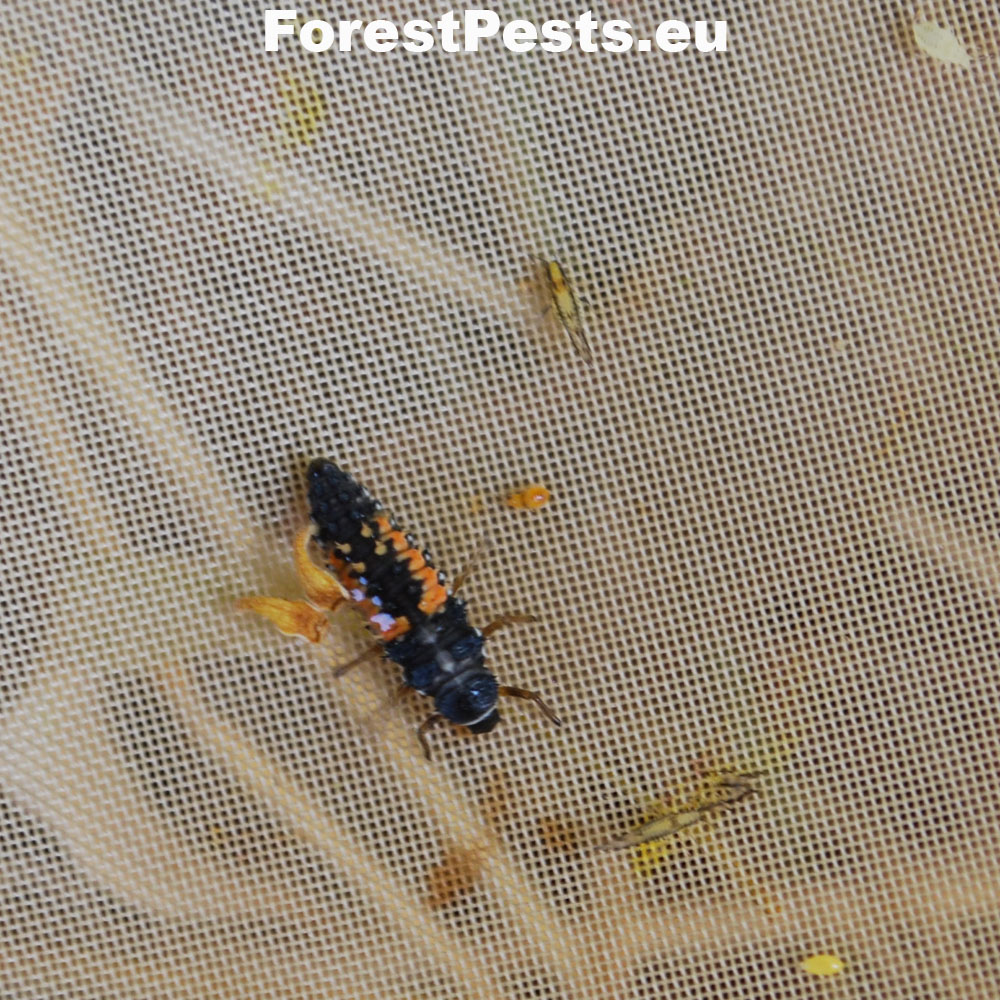
Larvae provide significantly better determination options. In the first and second instars, they are relatively homogeneous dark - gray-black, with two- to three-tip protrusions on the thorax and back of the body. The second instar larvae have a pair of yellowish spots on the first abdominal segment. Third instar larvae are characterized by orange rows of protrusions on the first to fifth abdominal segments. The fourth instar larvae have an orange cuticle around these protrusions and yellow-orange central protrusions on the first, fourth and fifth cells.
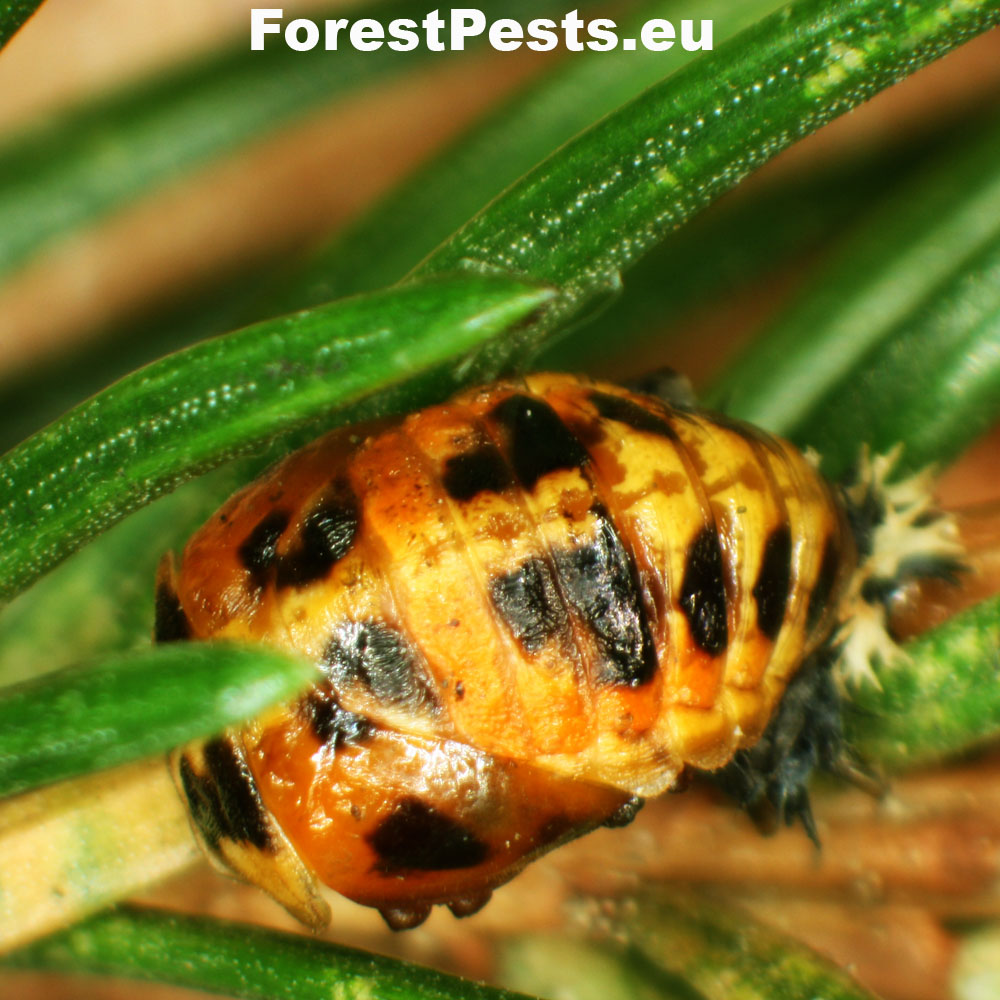
The pupa (pupa obtecta) is 5 - 7 mm long, orange with size-varying black spots (their size varies according to the temperature of larval development - thermal melanism), fixed at the end to the substrate.
The harlequin ladybird differs from other ladybird species by protrusions on the remnants of the larval exoskeleton (Nedvěd, 2014).
The imagines of the invasive population of the harlequin ladybird in Europe have a well visible crossbar on the back of the wing covers (elytra). It distinguishes this ladybird species from most native species without this bar (Nedvěd, 2014). Most individuals have white on the pronotum (the first segment behind the head). The black spots on the pronotum usually form an M-shaped mark when seen from the top and looking forward.
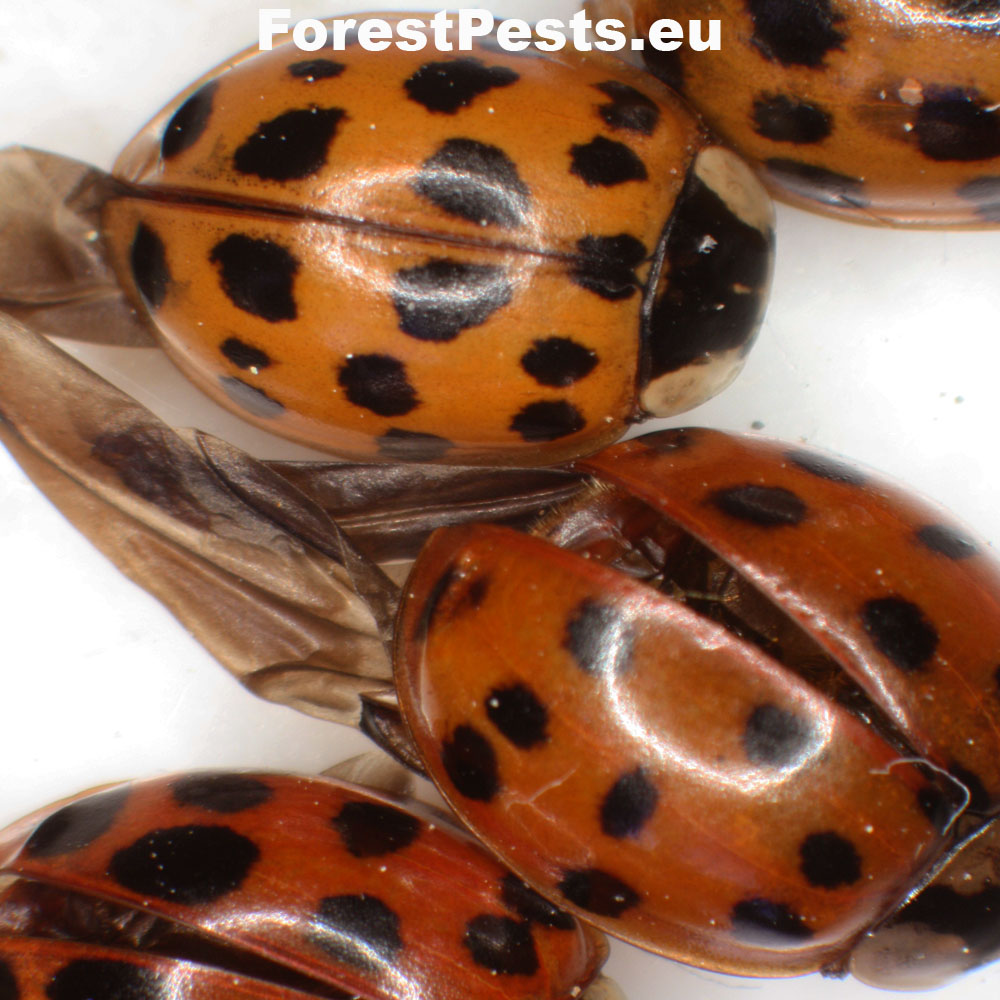
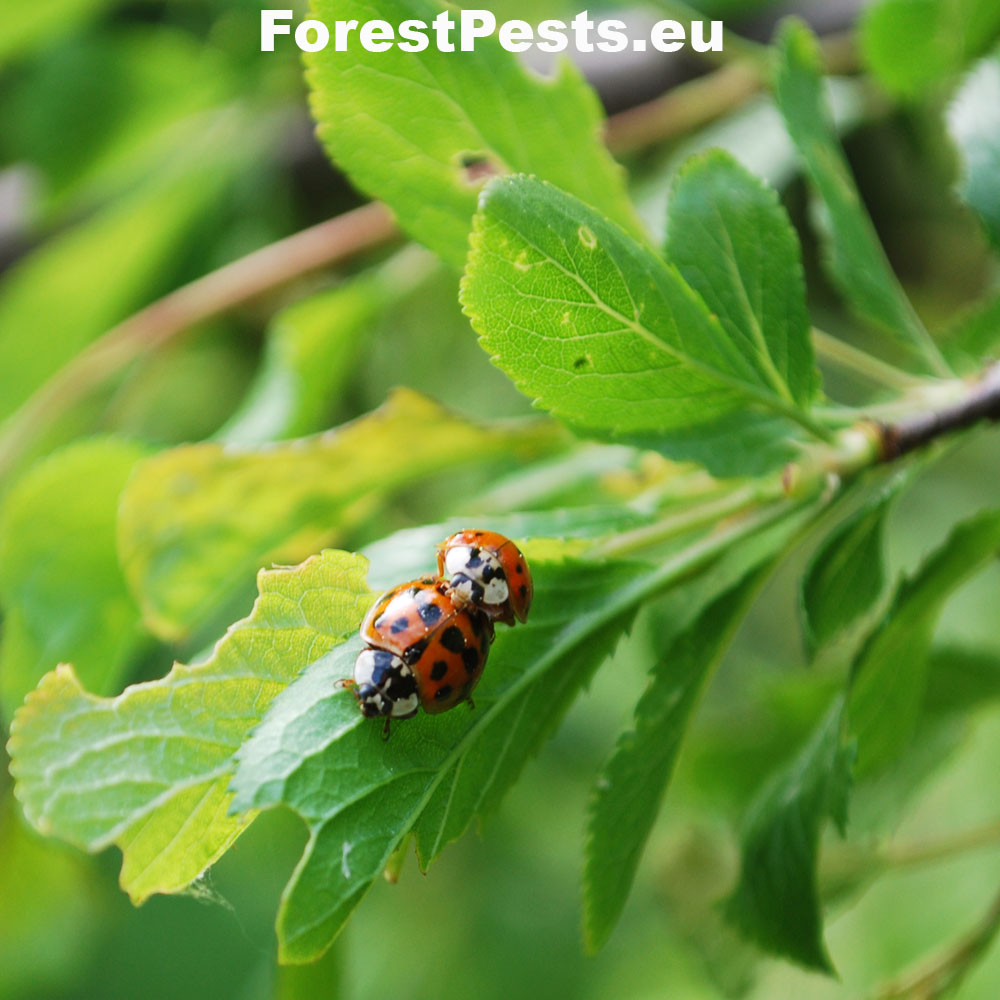
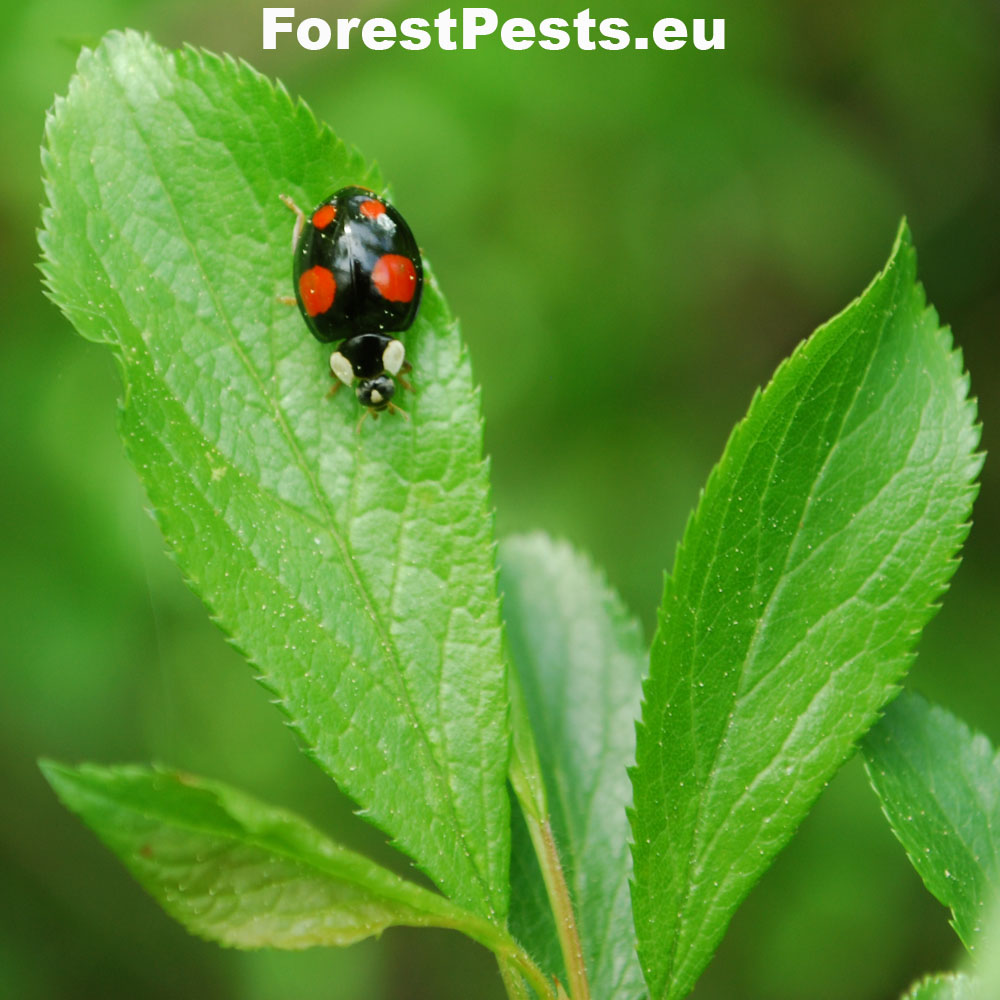
The size of the imagines (body length) is often over 5 mm (large species), which is also specified in our measurements: females - body length 6.0-7.5 mm (median 6.8 mm), body width 4.7-5, 9 mm (median 5.4 mm, n = 38), males - body length 5.8-7.0 mm (median 6.5 mm), body width 4.1-5.9 mm (median 5.1 mm , n = 34) (Zach, unpublished data). Females are slightly larger than males, but there is considerable overlap in body size between the sexes. The imagines of the harlequin ladybird are, in Central Europe, most often represented by three color forms easily distinguishable by the color of the wing-covers: (1) highly prevalent f. succinea (up to about 90% of all individuals) with yellow to red (red-orange) wing covers and a variable number of 0 to 19 dark spots; (2) melanic f. spectabilis with black wing covers and four red spots and (3) melanic f. conspicua with black wing covers and two red spots. In addition to the above forms, the axyridis form and even more rarely the equicolor form has been documented in Slovakia (S. Viglášová, unpublished data). Both of these forms are very rare also in the Czech Republic (Nedvěd, 2014).
Bionomy - infection cycle:
Harlequin ladybirds (Zach et al., 2013), same as native ladybirds in Central Europe, overwinter in the imago stage, often in large aggregations (Honěk, 1989). Aggregations of overwintering individuals are most often found in anthropogenic habitats, mostly in buildings and various objects (e.g., a roof over the well - 846 individuals - D. Jurina, unused space for the urn in the cemetery - 58 individuals - P. Zach, etc.). Less frequently documented are overwintering harlequin ladybirds in natural habitats, such as piles of rocks covered with dry grass (Panigaj et al., 2014). Expansion of harlequin ladybirds to human dwellings is often considered undesirable (Koch and Galvan, 2008). Therefore, aggregations of harlequin ladybirds are often removed from human dwellings. For example, in the spa in Sliač in 2011 and 2012, several complaints about the harlequin ladybird during its October migration were recorded (P. Zach, unpublished data). European populations of harlequin ladybirds have a weak diapause (Raak-van den Berg et al., 2012). Individuals are overwintering in warm buildings and leaving aggregations from January to March. These individuals are starving due to lack of food and dying prematurely (M. Mikuš, O. Nedvěd, P. Zach). Ladybirds aggregations in anthropogenic objects with a cold microclimate are more stable than populations in heated buildings (Raak-van den Berg et al., 2012, O. Nedvěd, P. Zach - unpublished data).
Depending on the air temperature, the harlequin ladybird leaves winter habitats from March to April. It is characterized by high fecundity and long-lasting fertility. A single fertilized female lays eggs in 20 to 80 pieces (Nedvěd, 2014). It can establish a new large colony even without a male (Awad et al., 2013). In Slovakia, it has two generations; in warmer positions, but three generations are also potential.
The primary way of spreading the harlequin ladybird is flight. The active spread of ladybirds is supported by wind and air streams. Its rapid expansion into new territories is significantly supported by transport, often over long distances and in a short time (Panigaj et al., 2014).
 |
 |
 |
|
Larva of the harlequin ladybird and aphids species Eucallipterus tiliae L. Photo: P. Zach |
Pupa of the harlequin ladybird on spruce.
Photo: P. Zach
|
Detail of the harlequin ladybird imago, form succinea. Photo: P. Zach |
It spread to Hungary in 2008 (Merkl, 2008). In the same year (2008), it was also for the first time recorded in Slovakia (Majzlan, 2008, Brown et al., 2011, Zach et al., 2013), where it became naturalized in most areas within five years (Panigaj et al., 2014). By the end of 2009, it was also detected in Ukraine and Romania (Nekrasova and Tytar, 2009, Marko and Pozsgai, 2009). Its spread to the east (towards the native population) continues.
The current distribution of the harlequin ladybird in Slovakia is mainly in the lower and middle parts from 100 to 400 m above sea level; the occurrence above 700 m above sea level is rare (Panigaj et al. 2014), but not surprising. Although the ladybird is widespread, there is little data on its occurrence, especially in mountain areas - for example, from the alpine spruces and meadows of Poľana Mountain (1306 m above sea level) in 2015 (J. Kulfan, O. Nedvěd, S. Viglášová, P, Zach, M. Zapletal - unpublished data). However, due to the excellent mobility of the imagines, it can also be expected on high mountain ridges, especially on warm summer days with proper thermal conditions.
Harlequin ladybird has the occurrence optimum in deciduous forests of lowlands and uplands (for example, oak, hornbeam, floodplain, and lowland pine forests). It is typically found in city parks, gardens with fruit trees (apples, peaches, plums), and vineyards. Particularly favorable conditions for its occurrence are provided by urban habitats, specifically urban settlements and rural landscapes with woody plants. It is common in ruderal habitats with abundant nettle (Urtica dioica) and in an open landscape with common reed Phragmites australis, with plenty of aphids.
 |
 |
|
Harlequin Ladybird's mating (form succinea)
on blackthorn. Photo: P. Zach
|
Harlequin ladybird, melanic form spectabilis.
Photo: P. Zach
|
Found in Slovakia: Yes
Invasive species: Yes
 |
|
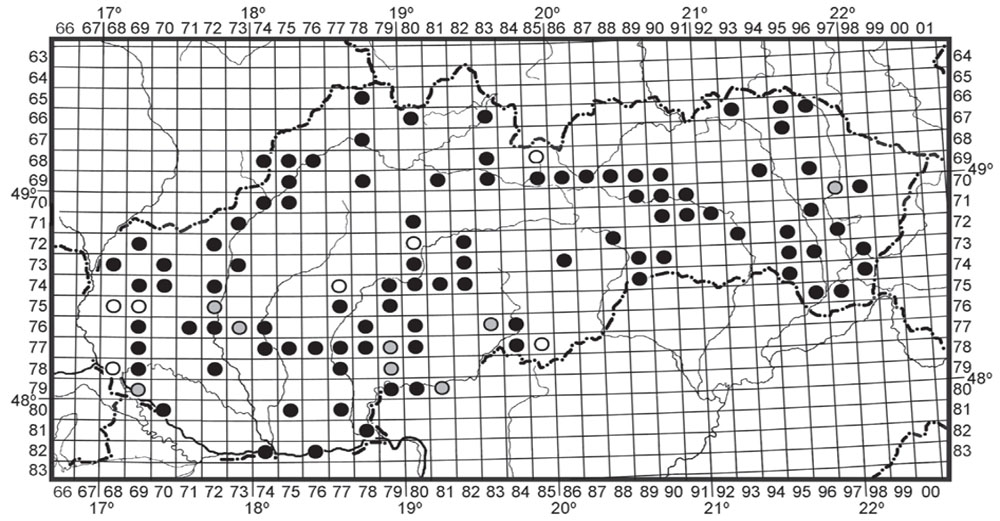
Records of (Harmonia axyridis) in Slovakia, 2008 – 2012.
(n = 153). White dots – year 2008, gray dots – year 2009, black dots – years 2010 to 2012 (Panigaj et al. 2014).
|
Awad, M., Kalushkov, P., Nedvědová, T., Nedvěd, O., 2013: Fecundity and fertility of ladybird beetle Harmonia axyridis after a prolonged cold storage. BioControl 58: s. 657-666.
Brown, P.M.J., Adriaens, T., Bathon, H., Cuppen, J., Goldarazena, A,, Hägg, T., Kenis, M., Klausnitzer, B.E.M., Kovář, I., Loomans, A.J.M., Majerus M.E.N., Nedvěd, O., Pedersen, J., Rabitsch, W., Roy, H.E.,Ternois, V., Zakharov, I.A. , Roy, D.B., 2008: Harmonia axyridis in Europe: spread and distribution of a non-native coccinellid. BioControl 53: s. 5-21.
Ceryngier, P., 2008: Ladybird conquers the world. Studying the expansion of H. axyridis in Poland. Research in Progress Ecology, Academia 3: s. 34-36.
Coutanceau, J.P., 2006: Harmonia axyridis (Pallas, 1773): une coccinelle asiatique introduite, acclimatée et an extension en France. Bulletin de la Société Entomologique de France 111: 395-401.
Gabel, B., 2015: Karanténnne a invazívne druhy – akútna hrozba pre slovenské vinohrady. Vinič a víno 1, s. 9-12.
Gordon, R.D., 1985: The Coleoptera (Coocinellidae) of America north of Mexico. Journal of the New York Entomological Society 93: 912 s.
Honěk, A., 1989: Overwintering and annual changes of abundance of Coccinella septempunctata in Czechoslovakia. Acta Entomologica Bohemoslovaca 86: s. 179-182.
Kenis, M., Adriaens, T., Brown, P., Katsanis, A., van Vlaenderen, J., Eschen R., Golaz l., zindel R., Sam Martin, Y., Gomez G., Bebendreier, D., Ware, R., 2010: Impact of Harmonia axyridis on European ladybirds: which species are most at risk? In: Benefits and risks of exotic biological control agents. IOBC/wprs Bulletin 58: s. 57-59.
Koch, R.L., Venetter, C., Hutchison, W.D., 2006: Invasions by Harmonia axyridis (Pallas) (Coleoptera: Coccinellidae ) in the Western Hemisphere: Implications for South America. Neotropical Entomology 35: s. 421-434.
Koch, R.L., Galvan, T.L., 2008: Bad side of a good beetle: the North American experience with Harmonia axyridis. BioControl 53: s. 23-35.
Kuznetsov, V.N., 1987: The
use of Far-Eastern lady beetles (Coleoptera, Coccinellidae) in biological control of plant pests. Informacionnyj Bjuletin EPS IOBC 21: s. 37-43.
Lombaert, E., Guillemaud, T., Cornuet, J.M., Malausa, T., Facon, B., Estoup, A., 2010: Bridgehead effect in the worldwide invasion of the biocontrol Harlequin ladybird. PLoS ONE 5: e9743.doi: 10.1371/journal.pone.0009743
Majzlan, O., 2008: Faunistical contributions from Slovakia, Coleoptera, 4. Naturae Tutela 12: s. 207-210.
Marko, V., Pozsgai, G., 2009: A harlekinkatica (Harmonia axyridis Pallas, 1773) (Coleoptera,Coccinellidae) elterjedése Magyarországon és megjelenése Romániában, Ukrajnában. (Spread of Harlequin Ladybird (Harmonia axyridis Pallas, 1773) (Coleoptera, Coccinellidae) in Hungary, and the first records from Romania and Ukraine). Növenyvédelem 45/9,481-490.
Merkl, O., 2008: First record of the harlequin ladybird (Harmonia axyridis Pallas) in Hungary (Coleoptera: Coccinellidae). Növényvédelem 44: s. 239-242.
Nedvěd, O., 2009: Spread and distribution of a non-native coccinellid Harmonia axyridis in Europe. In: Soldán T, Papáček M, Boháč J (Eds) Communications and abstracts, SIEEC University of South Bohemia, České Budějovice, s. 64-65.
Nedvěd, O., 2014: Slunéčko východní (Harmonia axyridis) – pomocník v biologické ochraně nebo ohrožení biodiverzity? Certifikovaná metodika pro praxi. Jihočeská univerzita v Českých Budějovicích, České Budějovice, 65 s.
Nekrasova, O.D., Tytar, V.M., 2009: A record of the Harlequin Ladybird Harmonia axyridis (Coleoptera, Coccinellidae) in Kyiv. Vestnik zoologii 43: s. 538-540.
Panigaj, Ľ., Zach, P., Honěk, A., Nedvěd, O., Kulfan, J., Martinková, Z., Selyemová, D., Viglášová, S., Roy, H.E., 2014: The invasion history, distribution and colour pattern forms of the harlequin ladybird beetle Harmonia axyridis (Coleoptera, Coccinellidae) in Slovakia, Central Europe. Zookeys, 412, s. 89-102.
Przewozny, M., Barozek, T., Bunalski, M., 2007: Harmonia axyridis (Pallas, 1773) (Coleoptera: Coccinellidae) new species of ladybird beetle for Polish fauna. Polskie Pismo Entomologiczne 76: s. 177-182.
Raak-van den Berg, C.L., Hemerik, L., de Jong, P.W., van Lenteren, J.C., 2012: Mode of overwintering of invasive Harmonia axyridis in the Netherlands. BioControl 57: s. 71-84.
Rabitsch, W., Schuh, R., 2006: First record of the multicoloured Asian ladybird Harmonia axyridis (Pallas, 1773) in Austria. Beiträge zur Entomofaunistik 7: s. 161-164.
Špryňar, P., 2008: Faunistic records from the Czech Republic – 252. Coleoptera: Coccinellidae. Klapalekiana 44: s. 77-79.
Zach, P., Honěk, A., Kulfan, J., Martinková, Z., Selyemová, D., Parák, M., 2013: Rozšírenie a ekológia lienky Harmonia axyridis (Coleoptera, Coccinellidae) na Slovensku. Zoologické dny Brno 2013, Sborník abstraktů z konference 7–8.2.2013, s. 251-252.
