

Corythucha arcuata
The oak lace bug is about 3 mm long. Its wings are milk-white, with brown markings. Nymphs are dark black, living on the underside of the leaves.
Imagines overwinter under the bark or in a forest litter. In the spring, they lay black eggs in groups of 15-100 pieces on the underside of the leaves. It can produce two to four generations per year, depending on the weather and altitude.
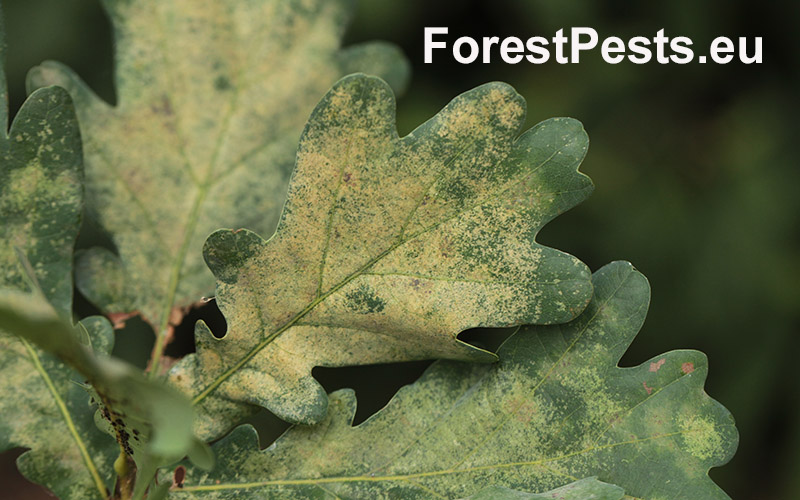
Juvenile (nymphal) and adults suck at the bottom of the leaves. There are also groups of black eggs and black dots of dried frass. In the second half of the summer, the infestation becomes visible as light yellow spots on the upper part of the leaves. Thus, the color of the whole tree gradually changes from yellow to ocher.
Corythucha arcuata (Heteroptera: Tingidae) is native to North America, widespread in the United States and Canada. The first specimens in Europe were recorded in Italy in May 2000 in one of the parking areas near Milan. It is known to be widespread today throughout Italy, in the regions of Lombardy and Piedmont. Corythucha arcuata was also detected in Switzerland in 2002 and Turkey in 2003. Within five years, the species has spread to much of Turkey, including nine provinces. In addition, its presence was confirmed in several localities near traffic routes and inside of cities in Bulgaria in 2012 and similarly in Hungary in 2013.
Particularly endangered are oak stands with the presence of Quercus cerris, Q. petraea, or Q. robur. In large forest complexes, the spread of this pest can be very rapid.
Prevent the spread of parts of infested trees.
Two seasons are recommended for the intervention, spring, and autumn. At the same time, according to current knowledge, the application in the autumn season brings better results.
Found in Europe: Yes
Invasive species: Yes
Similar species: