

Coleotechnites piceaella
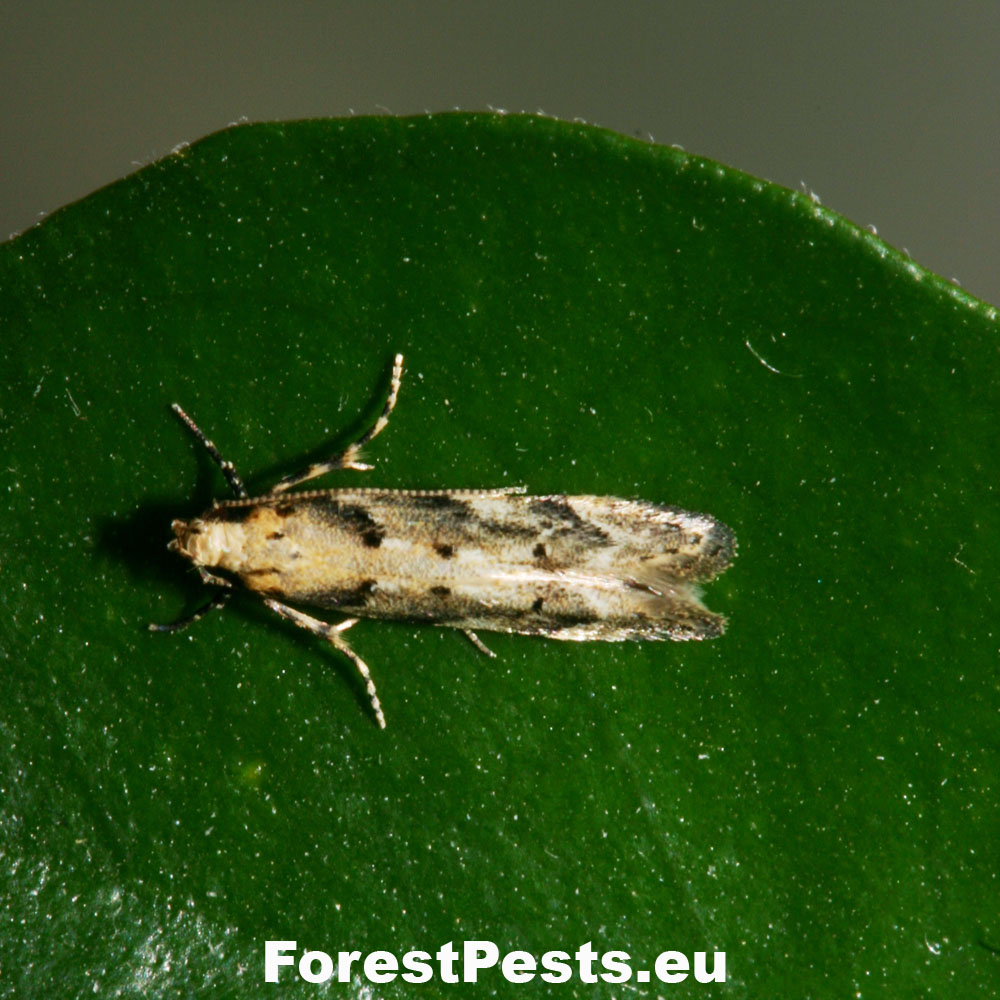
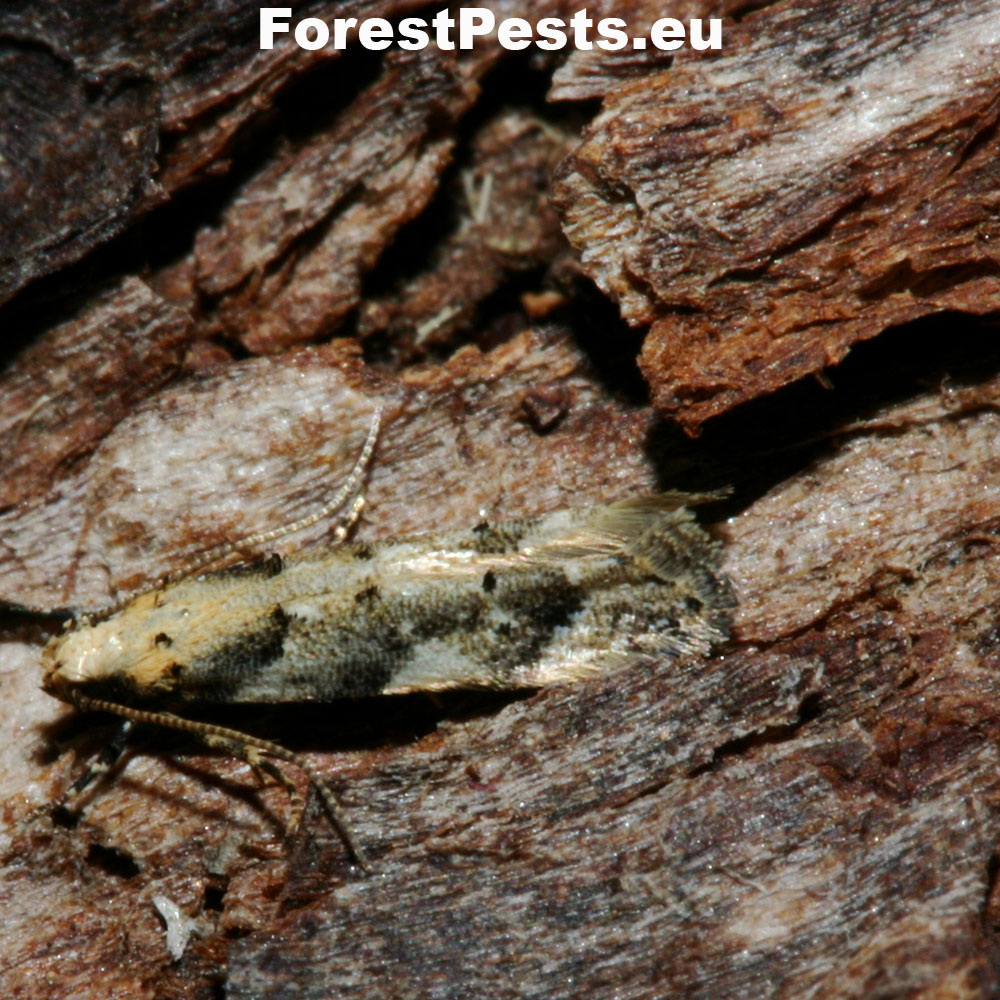
The Orange spruce needleminer moth is a small moth in the family Gelechiidae. It measures about 10 mm in the wingspan. It has noticeably long sickle-shaped lower-lip feelers. The forewings are narrow, light brown-gray colored with three oblique black stripes; the last strip (farthest from the wing base) is bent and lined on the distal side with a light stripe. Groups of protruding black flakes are also noticeable when magnified. The hind wings are narrow, bright, and cut below the top with long cilia. The resting moth has its wings pulled to its body; its forewings cover its hind wings.
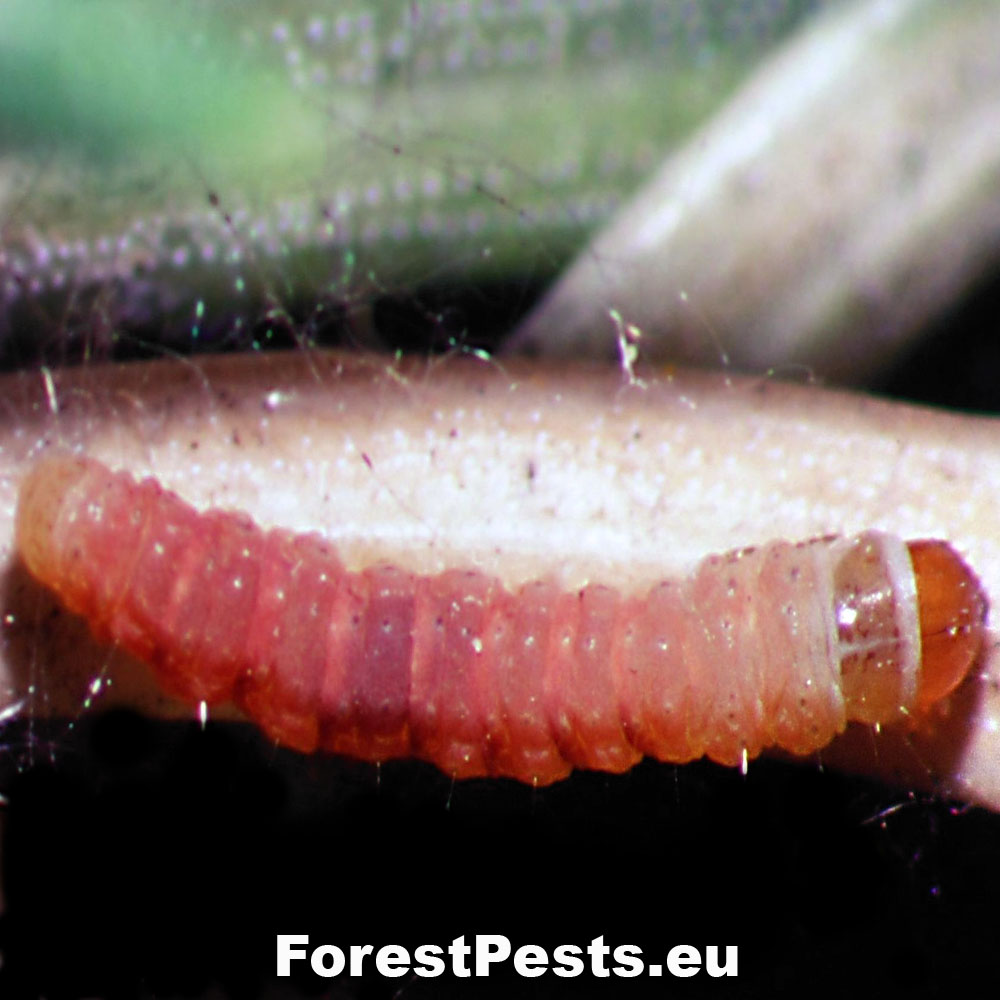
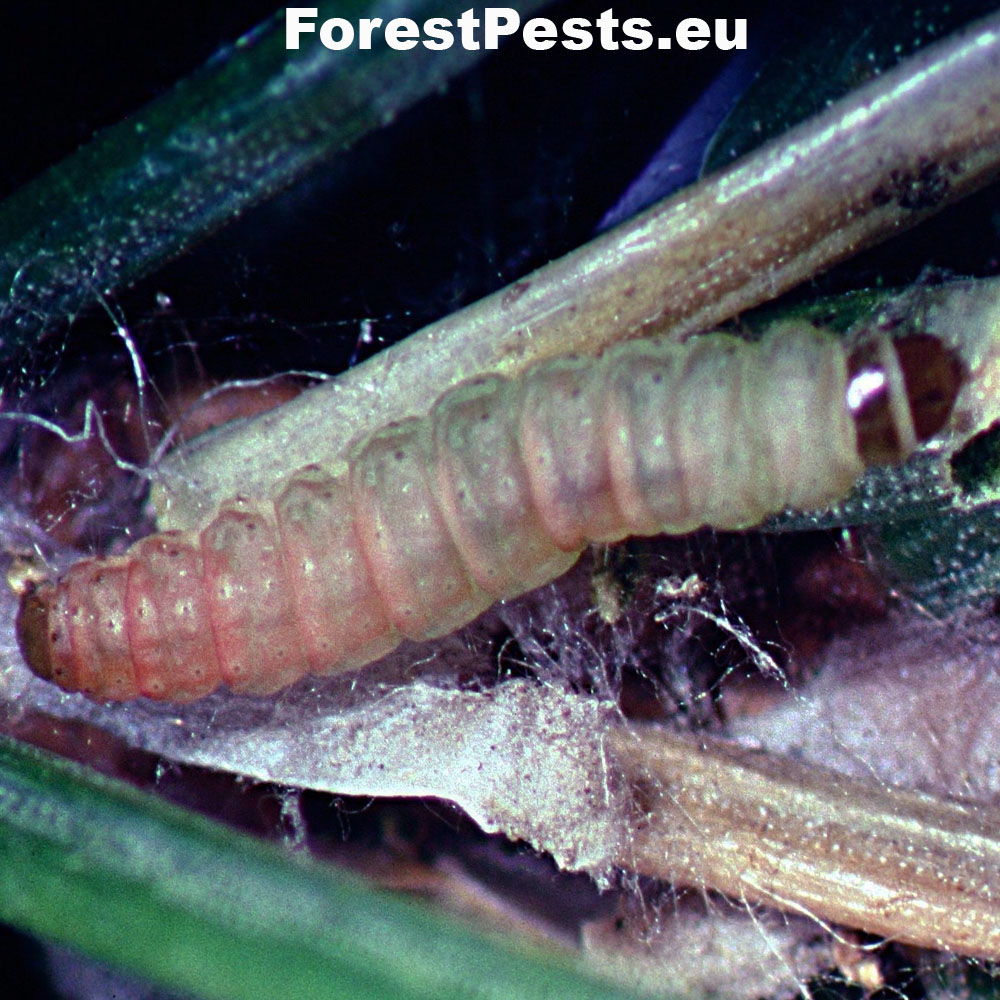
The adult caterpillar is 7-9 mm long. Its coloration is variable; literature data are not uniform (e.g., Führer, 1963). According to our records, the adult caterpillars are light, greenish to brownish (or even pink), while one color can flow smoothly into another. The head is gray, as well as the prothoracic shield and anal shield. The pinnaculum is darker than the rest. There is a distinct anal comb at the end of the body. Smaller caterpillars are darker than adults, reddish-brown with a brown head and a slightly darker prothoracic shield. Characteristic signs can be observed with a stereo magnifying glass.
The eggs are oval, relatively large due to the size of the moth (0.4 x 0.3 mm).
Bionomy - infection cycle:
Orange spruce needleminer attacks trees of various ages. Damage was recorded in our country, mainly in the urban environment. However, in one case, trees were also damaged in forest vegetation outside the city, where we estimated damage of old needles on some branches of blue spruce up to about 50% (Kulfan et al., 1998b).
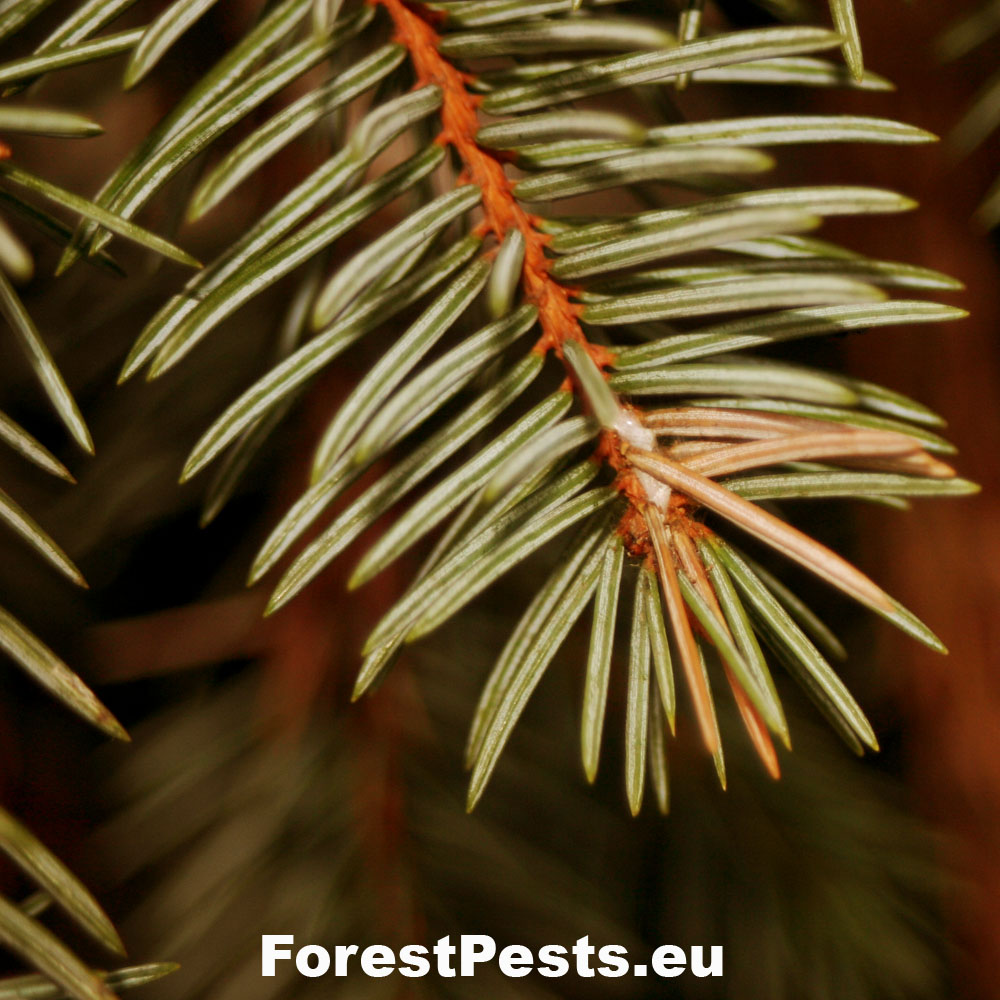
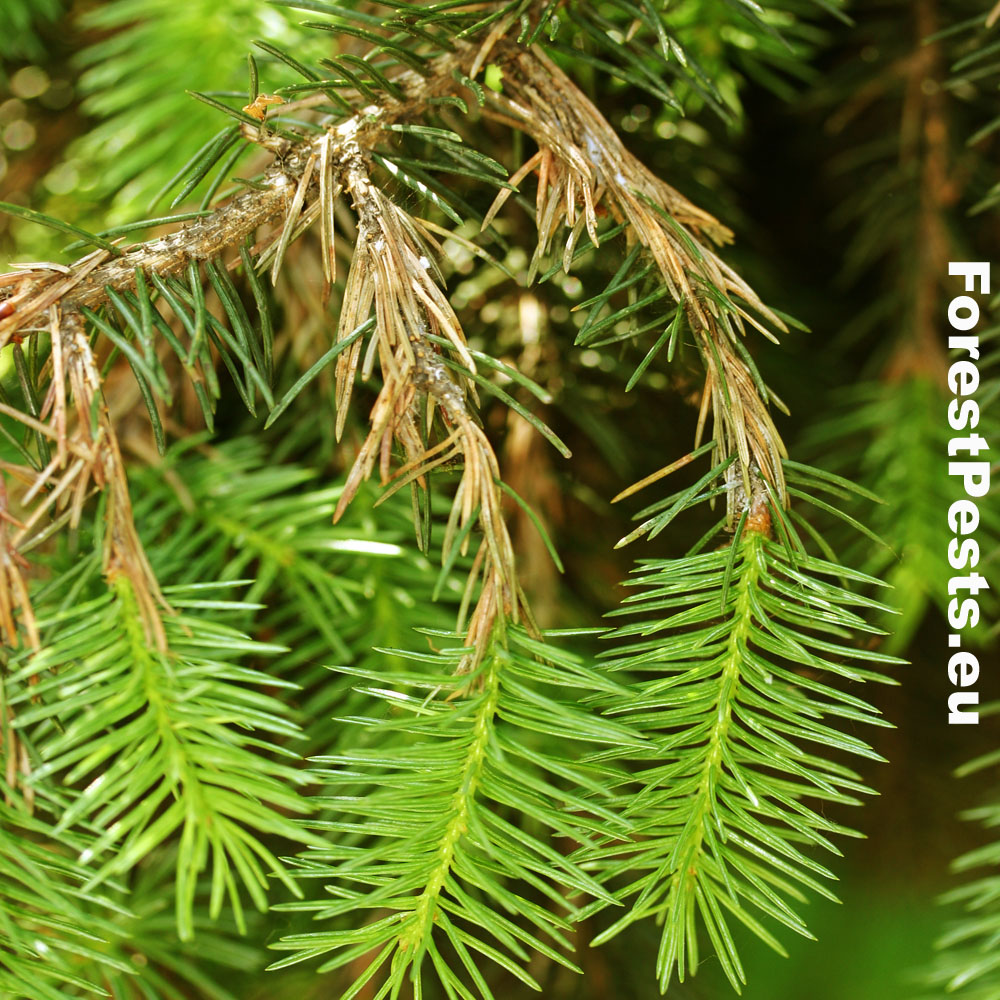
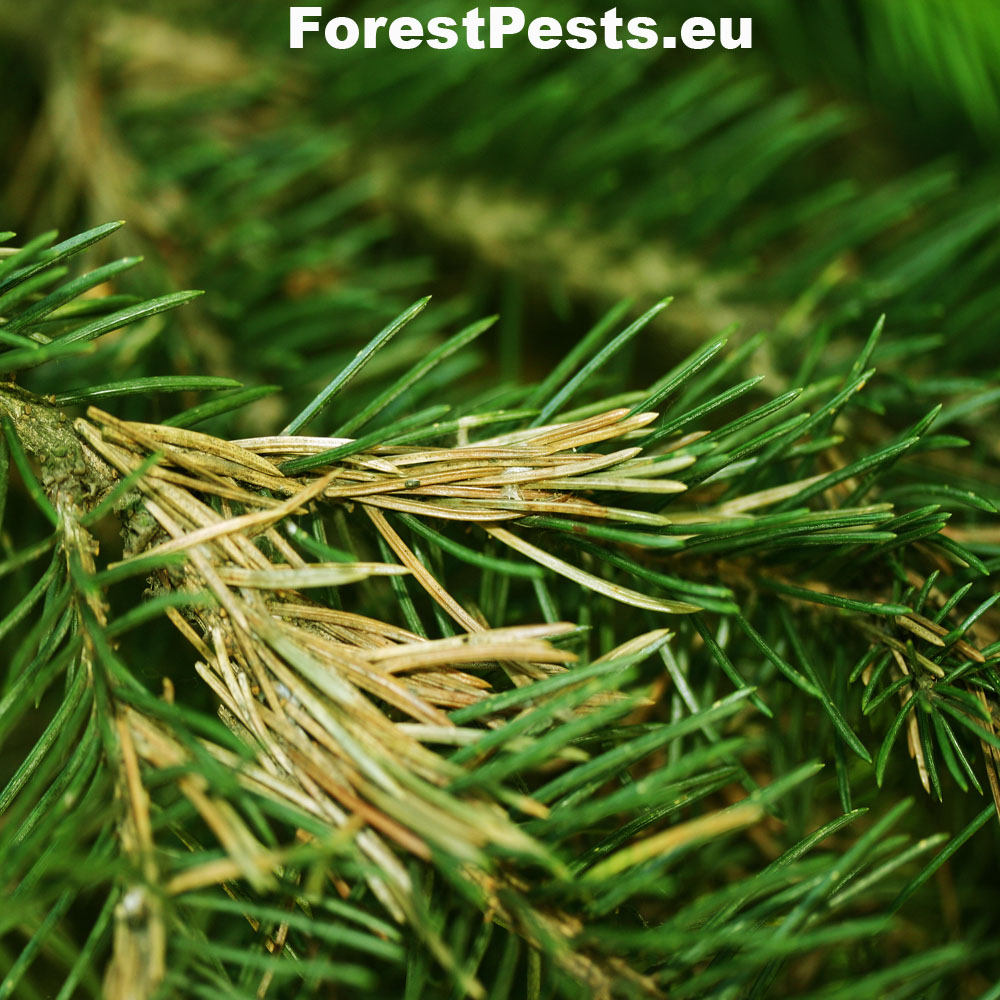
Needles on young shoots are never attacked; damage to new needles can usually be observed only at the end of summer and in autumn (individual mined needles or groups of several needles with mines). However, significant damage can be observed in the spring, shortly before the budding of new shoots, when the caterpillars destroy many needles after overwintering. After growing new shoots, these will temporarily cover the damaged older needles.Characteristic is a group of mined needles forming an "islet" on the branch. Freshly mined needles are pale brown; later, they turn brown to reddish-brown when they dry completely. They fall off after some time but remain attached to the branches by the fibers and then look like dry needles fallen from the higher floors of the spruce. However, they are connected by basal parts with more or less functional fibers, so they stick together even after falling off the branch. In addition, each needle has at least one hole (usually in the basal part). Thanks to the mentioned fibers, such destroyed needles will remain on the branches for a longer time (at least several months). One or more mined needles on new shoots can be found in the autumn, which means that caterpillars are present on the tree in a given year. The most infested needles are in the depths of the crown on older branches. New shoots around the crown edges cover the damaged parts of the branches so that even a heavily infested tree may appear undamaged.
 |
 |
 |
 |
|
Imago, top view.
Photo: J. Kulfan
|
Imago, side view.
Photo: J. Kulfan
|
A young caterpillar of the orange spruce needleminer.
Photo: J. Kulfan
|
A full-grown caterpillar of the orange spruce needleminer
Photo: J. Kulfan
|
Orange spruce needleminer prefers spruce trees. In our conditions, there are reports on blue spruce (Picea pungens), Norway spruce (P. abies), and Serbian spruce (P. omorika). Blue spruce is most attacked, regardless of whether it is silver or green cultivars. In North America, it has been found in many species of domestic spruces - P. glauca, P. pungens, P. engelmannii, P. abies, P. rubens, P. mariana (Holzschuh, 1987) as well as in European P. abies. Fir Abies balsamea is also mentioned in the literature (https://en.wikipedia.org/wiki/Coleotechnites_piceaella). In our country, domestic and introduced spruce species and possibly other conifers are endangered.
Damaged plant parts: Leaf/needle
Significance: Significant
Origin and distribution:
Orange spruce needleminer occurs naturally in North America, mainly in southern Canada and the eastern part of the USA (http://mothphotographersgroup.msstate.edu/species.php?hodges=1826). It was found in Great Britain (https://en.wikipedia.org/wiki/Coleotechnites_piceaella) in 1952 and in Germany in 1962 (Führer, 1963a, 1963b). It currently occurs in a large area of Europe, from Great Britain to the Balkans (Karlsolt, Razowski, 1996, Timuş 2015). It has been found in Sweden (Svensson, 2010) and Italy (Karlsolt, Razowski, 1996, Hellrigl, 2006) etc.
Endangered stands and areas:
Various spruce species in urban greenery are particularly endangered. Christmas tree plantations can also be potentially endangered.
Prevention:
No effective measures are known to prevent the infestation of spruce. It is necessary to carefully check the purchased spruces planted as ornamental trees and possibly eradicate the caterpillars. Small galleries and eggs are practically undetectable during an inspection.
Monitoring:
Galleries, especially in spring, are easy to find. These are apparent, but care must be taken to ensure that the originator is correctly identified. Recording considerable damage to the current season's new needles in the autumn means a more severe threat to the host trees in the following year. At the same time, preventive control of planted trees in the urban environment is needed. Determination of caterpillars obtained, e.g., in photoeclectors, requires a specialist; a pink or fleshy red color of caterpillars is a distinguishing mark. The inexperienced observer can consider dry needles as "ordinary" needles fallen from higher branches or dried due to abiotic factors (drought, immissions and road salt, nutritional deficiencies, frost). Caterpillars can only be reliably determined using a binocular magnifier or a strong hand magnifier. In the case of a massive infestation, the moths resting in spruce crowns can be immediately registered, e.g., by shaking the branch, it flies out.
Pest control:
The usual procedures against caterpillars of other spruce miners can be used (Kulfan et al., 1999a).
Pest classification: Leaf-eating insect
Found in Europe: Yes
Invasive species: Yes
Similar species:
The most similar galleries on spruce are caused by the European spruce needleminer (Epinotia nanana). It also has a similar development cycle. Galleries can be reliably determined only by the caterpillar. It is usually lighter (pale brown), has no anal comb, cilia are obscure, and has two cilia coming from one pinnaculum on top of the 9th abdominal segment (they are two merged shields - the sign of family Tortricidae).
The other two types of miners on spruce - the Pine Cosmet (Batrachedra pinicolella) and the Chionodes electella - have a similar bionomy and galleries, but they deposit frass in cocoons. Their caterpillars are dark brown, darker than the caterpillars of the orange spruce needleminer moth.
The imagines of these species also differ. The European spruce needleminer has dark gray-brown and less colorful forewings; the Pine Cosmet has a very narrow fore and hindwings with very long cilia, the forewings are light yellowish-brown without drawings, with only two dots. The orange spruce needleminer is bigger than the above species (13 - 14 mm), gray-white with dark spots.
Caterpillars of European spruce budmoth (Epinotia tedella) occur on spruce in late autumn and early winter where they mine needles (usually larger groups of needles), connected by a denser web, in which they deposit frass. The caterpillars are pale brown, mostly with two significant brown-red stripes on the back. The imagines are dark brown with white stripes and spots on the forewings.
 |
 |
 |
|
Galleries of a young caterpillar of orange spruce needleminer in the autumn. Foto: J. Kulfan
|
Galleries of caterpillars of orange spruce needleminer in the spring. . Foto: J. Kulfan |
Groups of mined needles break off but remain attached by fibers on a branch for a long time
Foto: J. Kulfan
|
References:
Drooz A. T., 1985: Insects of eastern forests. Miscellaneous Publication, US Department of Agriculture, Washington DC, 608 pp.
Führer E., 1963a: Die amerikanische Fichtennadel-Miniermotte in Deutschland. Allgemeine Forstzeitschrift, 18: 430-431.
Führer E. 1963b: Recurvaria piceaella Kearfott (Lep., Gelechiidae), die amerikanische Fichtennadel-Miniermotte, an Picea pungens in Deutschland. Anzeiger für Schädlingskunde, 36: s. 93-94.
Galko J., Zúbrik M., Vakula J., Gubka A., Úradník M., 2012: Aktuálne hrozby z šírenia inváznych druhov hmyzu na Slovensku. Aktuálne problémy v ochrane lesa, 2012, s.129-140.
Hellrigl K., 2006: Rasche Ausbreitung eingeschleppter Neobiota (Neozoen und Neophyten). Forest observer, 2: s. 349-388.
Holzschuh C., 1987: Die amerikanische Fichtennadel-Miniermotte Coleotechnites picaeella (Kearfott) jetzt auch in Österreich nachgewiesen (Lepidoptera, Gelechiidae). Anzeiger für Schädlingskunde, Pflanzenschutz, Umweltschutz, 60: s. 90-92.
http://www.andrejmakara.com/index.php/fotozbierky?page=view&catid=808&imgid=7999&PageNo=32769&key=3&hit=1
http://www.fotonet.sk/?idi=7889
http://mothphotographersgroup.msstate.edu/species.php?hodges=1826
http://www.bladmineerders.nl/minersf/lepidopteramin/coleotechnites/piceaella/piceaella.htm
https://en.wikipedia.org/wiki/Coleotechnites_piceaella
Kulfan J., Patočka J., Zach P., 1998a: Nový škodca okrasných smrekov - psota Coleotechnites piceaella. Záhrada-Park-Krajina, 1998(6): s.12-13.
Kulfan J., Patočka J., Zach P., 1998b: Nový škodca smrekov na Slovensku – psota Coleotechnites piceaella, p. 229-231. In: Petráš R. (ed.), Lesy a lesnícky výskum pre tretie tisícročie. Lesnícky výskumný ústav, Zvolen.
Kulfan J., Turčáni M., Patočka J., Zach P., 1999a: Budú smrekové porasty na Slovensku ohrozené zavlečeným škodcom - mínovačom Coleotechnites piceaella ? Les, 55 (5): s. 20-21, 30.
Kulfan J., Zach P., Juhásová G., 1999b: Poškodenie smrekov húsenicami málo známeho škodcu - amerického motýlika Coleotechnites piceaella, p. 77-81. In: Juhásová, G., Pestovanie a ochrana rastlín v mestskom prostredí, ošetrenie chránených a pamätných stromov. Zborník zo seminára. Ústav ekológie lesa SAV, Pobočka biológie drevín, Nitra.
Reiprich A., 1991: Prírastky motýlej fauny na Slovensku v roku 1990. Správy Slovenskej entomologickej spoločnosti pri SAV, 3: 20-23.
Schnee H., 2000: The American spruce needle-miner (Coleotechnites piceaella (Kearfott)) (Lepidoptera, Gelechiidae) in Saxonia-distribution, bionomy, parasitoids. Mitteilungen der Deutschen Gesellschaft für allgemeine und angewandte Entomologie, 12: 523-526.
Svensson I., 2010: Anmärkningsvärda fynd av småfjärilar (Microlepidoptera) i Sverige 2009. Entomologisk Tidskrift, 131: 17-27.
Timuş A. M., 2015: The invasive entomofauna of the Holometabola group, superorder Mecopteroidea for Republic of Moldova. Current Trends in Natural Sciences, 4(7): 50-58.
Vakula J., Gubka A., Zúbrik M., Kunca A., 2011: Nové metódy ochrany lesa proti lykožrútovi severskému a iným inváznym druhom. Národné lesnícke centrum, Zvolen, p. s. 92-94.
