

Anoplophora glabripennis
Species description:
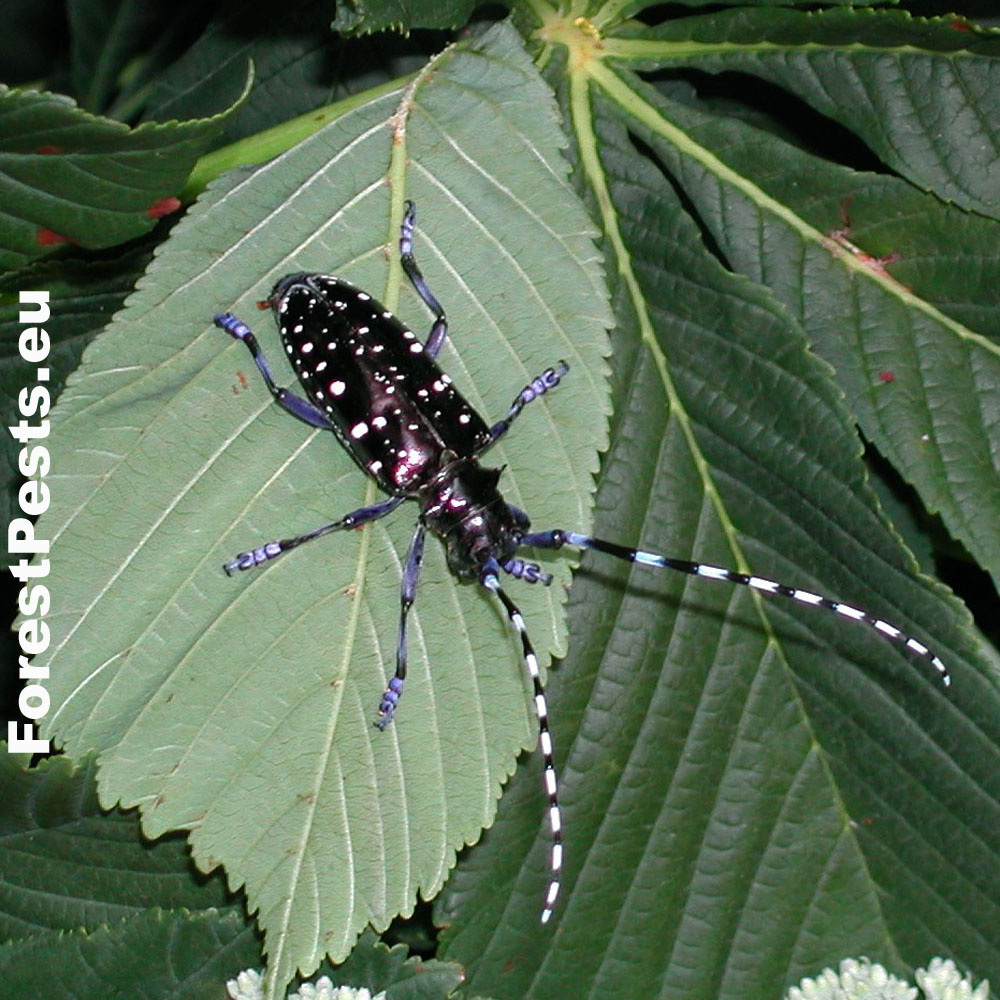
The Asian long-horned beetle belongs to the large species of long-horned beetle. The body of the imago ranges from 25 mm (mostly males) to 35 mm (mostly females). The antennae of females are 1.3 times and males 2.5 times as long as the body of the insect. The body is shiny black with 10 to 20 irregular white spots on the black wing covers. The antennae have 11 segments; the bases are bright with a bluish touch (Fig. 1). The female lays 5-7 mm large whitish eggs of oblong shape in the bark of trees; before larva hatching, the color of the egg changes to yellow-brown. The creamy white larva (up to 50 mm in size depending on the stage of development) with a chitinized mark on the prothorax has no legs, which distinguishes it from most other species of long-horned beetles.
The larval galleries are very similar to the galleries of other long-horned beetle species. They are unnoticeable under the bark, oval-shaped, gradually spread with the growth of the larva up to 30 cm long, extend into the core wood. At the end of the larval gallery in the wood near the bark is a pupal chamber. Chamber is separated from the gallery by compressed fine frass. The imago gnaws to the surface by large round exit holes (approximately 10 mm diameter ). It consumes leaves from the edge, feeding on the leaf stalk often leads to the leaf falling. Feeding on the twigs creates small areas, similar to the female gnawing the egg-laying pits.
Bionomy - infection cycle:
In the home country (China), the number of annual generations varies with climate. It takes one generation per year to develop, and in the northern parts, a generation may take 1.5 years to develop, while in the north part, a single generation takes two years to develop.
In Central Europe, development usually takes two years, but in the warmer years, it can be reduced to 1.5 years (Forster and Wermelinger, 2012). The imagines leave the galleries in May to October and live for one to two months. They usually remain on the tree in which they developed or fly over to neighboring trees. They do not fly over long distances (up to 250 to 500 m). However, when they disperse, they can travel up to approximately 1 to 3 km (Smith et al., 2002) from their host tree. Flight activity is mainly related to warm and sunny weather. They feed on leaves and leaf stalks as well as young bark of branches (maturity feeding). The laying of eggs begins about a week after mating. The female lays 30 - 60 eggs (occasionally up to 200) in their lifetime by chewing a small pit through the host tree's bark to the cambium up to 3 cm. After two weeks, the larvae hatch. They first feed in the cambial area, but more mature larvae tunnel to the heartwood as they feed. The pupae are well sealed by frass in the chambers. Adult beetles emerge by boring round exit holes. Females are attracted by a combination of male pheromones and volatile substances of the host tree; males are attracted only by volatile substances (Nehme et al., 2010). The long-horned beetle spreads over long distances in the transported wood.
.jpg) |
 |
.jpg) |
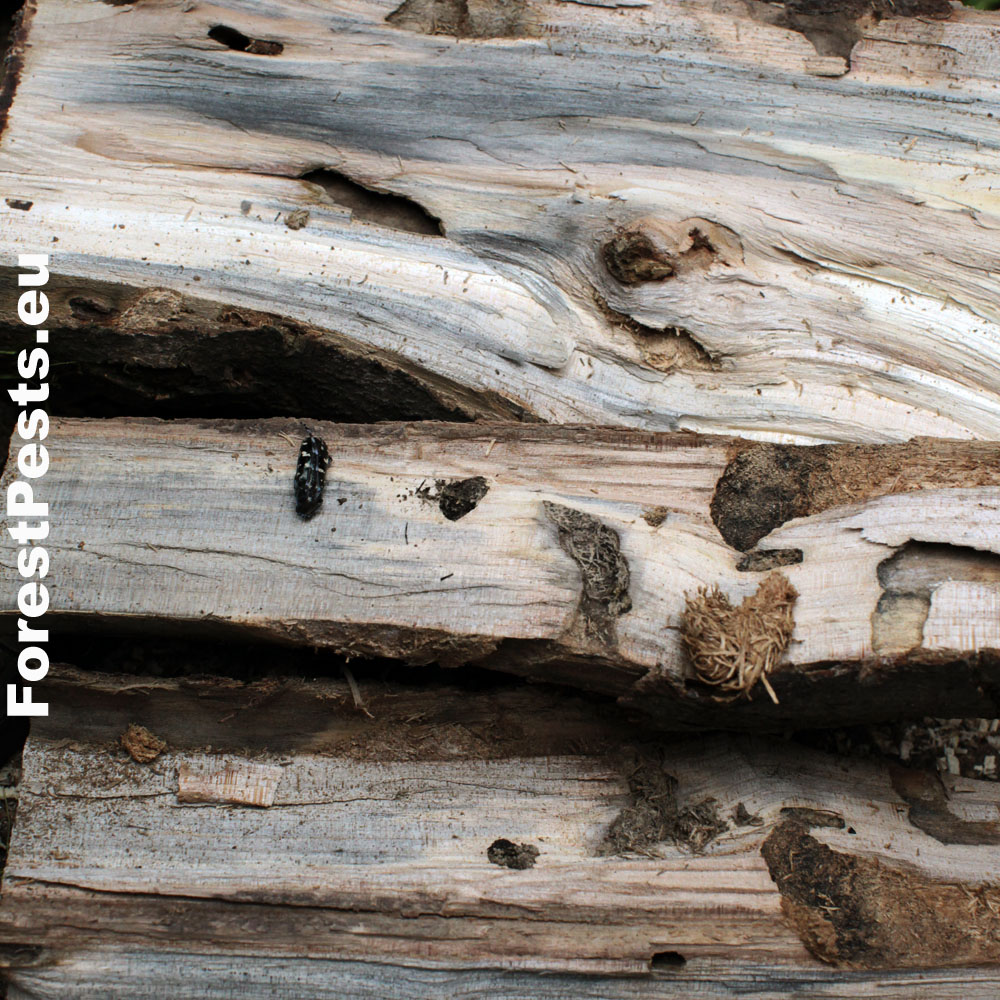 |
| Exit holes. Foto: M.Zúbrik |
Imago. Foto: Hannes Krehan,
Bundesamt für Wald
|
Larva. Foto: Hannes Krehan,
Bundesamt für Wald
|
Galleries. Foto: M.Zúbrik |
Symptom:
Infested trees can be recognized by the maturity feeding of beetles on twigs, traces of feeding on the surface of the bark (females lay eggs in the gnawed areas), and the outflow of sap from the larval tunnels in the cambial zone. Larval activity is recognized by galleries under the bark and, later, tunnels in the wood. Masses of wood shavings extruding from round exit holes are signs that adults have emerged from infested wood. The wood shavings extruded from the galleries often accumulate at the base of the infested tree trunk. The trees are more infested on the southern side of the trunk. Here can be found large exit holes, usually in the middle and top of the tree. The resin leaking from the wounds (after the beetle feeding in the bark) attracts secondary pests and can be a fungal infection source. Infested trees with reduced turgor have smaller leaves that turn yellow, hang and fall off, while the canopy cover of stands is significantly reduced (Nowak et al., 2001). Wood damaged by long-horned beetle larvae can be considerably devalued (Gao et al., 1993). Mechanically weakened branches on infested trees are easily broken. Weakening the structural strength of wood by larvae feeding on trees in an urban environment (cities, villages, etc.) presents a significant danger to pedestrians, cars, and buildings by broken branches.
Endangered trees:
International trade with China poses a significant risk of introducing the Asian long-horned beetle into Europe (MacLeod et al., 2002). According to expert forecasts, the optimal environment is in southern Europe, where it can cause the most significant damage. China's primary host woody plants are poplar and its hybrids (Populus nigra, P. deltoides, P. x canadensis, P. dakhuanensis) and willows (Salix spp.). However, as a broad polyphagous, it also lives on maple, alder, apple, mulberry, sycamore, pear, plum, birch, locust, elm, and other woody plants. In the USA, it lives most often on maple, occasionally also on horse chestnut, Chinese tulip poplar, and white mulberry. In Europe (Switzerland), for example, sycamore maple (Acer pseudoplatanus), Norway maple (A. platanoides), field maple (A. campestre), and goat willow (Salix caprea) (Forster and Wermelinger, 2012).
Damaged plant parts:
The adult beetles damage the leaves, twigs, and bark, the larvae damage branches and trunks (from 3 cm diameter).
Significance:
Unlike many other long-horned beetles species, A. glabripennis attacks healthy trees and trees exposed to stress. Several generations of beetles can develop in one tree. It is an important pest, limited in our climatic conditions with a narrow occurrence in some countries.
Origin and distribution:
The Asian long-horned beetle comes from China, where poplars began to be intensively grown in the 60s of the last century on plantations or planted en masse around roads and farms. Some planted poplar hybrids (not native to China) have become very suitable for Asian long-horned beetle. As a result of favorable conditions, the number of beetles in poplar plantations has increased significantly. It has led to a higher intensity of damages to other tree stands, including fruit and ornamental trees. With commodities from China, the abundant Asian long-horned beetle penetrated the USA (New York City, 1993? - 1996, Illinois (Chicago, 1993? - 1998) (USDA/APHIS, 1996, USDA, 1998, EPPO, 2012b)) and was later unintentionally introduced to Europe. There is an ongoing effort to eradicate its occurrence on both continents.
In Europe, the Asian long-horned beetle was first detected in Braunau am Inn, Austria, in November 2000; officially confirmed in July 2001 by finding an adult (Dauber and Mitter, 2001 Tomiczek and Hoyer-Tomiczek, 2007, Krehan, 2008). Later, it was found in Belgium, Denmark, France, Germany, the Netherlands, Poland, and the United Kingdom (EPPO, 2012a) and in 2011 in Switzerland (Forster and Wermelinger, 2012). Other findings are being made, for example, in the United Kingdom (Forestry Commission, 2012). The species has not been recorded in Slovakia yet, but its occurrence in neighboring Austria requires increased attention, from where it could be transported with trade commodities to Bratislava and the surrounding floodplain forests with the domination of poplars and willows. However, the Asian long-horned beetle can also be transported to unexpected places through wooden pallets from China.
Endangered stands and areas:
The endangerment of woody plants in the urban environment and floodplain forests is expected, mainly in the vicinity of Bratislava and in the Danube region. Also, orchards and ornamental plantings throughout Slovakia are at high risk.
Monitoring:
Pest category: Insects (phytophagous, phloeophagous, xylophagous)
Found in Slovakia: no
Asian long-horned beetle is an introduced species with a local occurrence in Europe. Therefore, the European and Mediterranean Plant Protection Organization (EPPO) categorizes it as a quarantine species (EPPO, 2012b).
Similar species:
Differentiation from other species - some DNA markers are known for molecular identification of all instars and galleries of the Asian long-horned beetle, which distinguishes it from other species (Kethidi et al., 2003). In Europe, there is a similar species of long-horned beetle - Anoplophora chinensis, a quarantine pest (EPPO/CABI).
Literature
Dauber, D., Mitter, H. 2001: Das erstmalige Auftreten von Anoplophora glabripennis (Motschulsky 1853) auf dem europäischen Festland (Coleoptera: Cerambycidae: Lamiinae). — Beiträge zur Naturkunde Oberösterreichs 10: 503 – 508.
EPPO, 2012a: EPPO Plant Quarantine Data Retrieval System, PQR-version 5.0. — Downloaded from http://www.eppo.int/DATABASES/pqr/pqr.htm on 9.10.2012.
EPPO, 2012b: EPPO A1 List of pests recommended for regulation as quarantine pests. Version 2011–09. — Downloaded from http://www.eppo.int/QUARANTINE/listA1 on 20.09.2012.
Forestry Commission, 2012: Exotic beetle pest of trees found in Kent. News Release, No: 15381, No: 15381., UK: Forestry Commission. http://www.forestry.gov.uk/newsrele.nsf/web-allbysubject/ADF25B31C39D4A5F802579CF00367EE9
Gao R.T., Qin X.F., Chen D.Y., Chen W.P., 1993: A study on the damage to poplar caused by Anoplophora glabripennis. Forest Research, 6:189 – 193.
Krehan, H., 2008: Asian longhorn beetle Anoplophora glabripennis (ALB)–eradication program in Braunau (Austria) in 2007. Forstschutz Aktuell 44, 27-29.
Liang, C.J., Li, G.H., Li, G.W., Gao, R.T., Zhao, Z.Y., Sun, J.Z., 1997: Study on the use of systemic and pyrethroid insecticides to control Anoplophora glabripennis and Apriona germarii. Forest Research, 10: 189 – 193.
Nehme, M.E., Keena, M.A., Zhang, A., Baker, T.C., Hoover, K. 2010. Evaluating the use of maleproduced pheromone components and plant volatiles in two trap designs to monitor Anoplophora glabripennis. Environmental Entomology, 39: 169 – 176.
OEPP/EPPO, 2003. EPPO Reporting Service 2000/038, 2000/147, 2000/164, 2002/070, 2003/066, 2003/124. Paris, France: EPPO.
Smith, M.T., Bancroft, J., Tropp, J. 2002: Age-specific fecundity of Anoplophora glabripennis (Coleoptera: Cerambycidae) on three tree species infested in the United States. EnvironmentalEntomology, 31: 76 – 83.
USDA, 1998. Asian long horn beetle web pages, www.aphis.usda.gov/oa/alb/.
USDA/APHIS, 1996. New Pest Advisory Group report on Anoplophora glabripennis (an exotic Asian longhorned beetle), September 25, 1996. Unpublished Agency report, www.aphis.usda.gov/ppq/bbnpag.html.
