


 Show all photos in album
Insert for comparison
We will identify your pest
Add pictures of this species
Show all photos in album
Insert for comparison
We will identify your pest
Add pictures of this species
Xylosandrus crassiusculus
Asian ambrosia beetle
Description
The Asian ambrosia beetle (Xylosandrus crassiusculus) is a small red-brown beetle. Females are larger than males, measuring 2.2-2.5 mm, and can fly, while males are approximately 1.5 mm long, flightless, and remain in galleries. The larvae are white, legless, and C-shaped. Typically, one male mates with around 10 females, often fertilizing their sisters, similar to its relative, the black timber bark beetle (Xylosandrus germanus). These species are quite similar in their way of life and morphology. After leaving the gallery, a fertilized female searches for suitable wood to establish a new generation. She bores into the wood and creates a tunnel ending in a chamber or with several side tunnels, where she lays her eggs. The larvae feed on ambrosia fungi that grow on the tunnel walls, chamber, and side tunnels. In its native range (tropical and subtropical Asia), overlapping generations occur due to year-round favorable conditions. In Southeastern America, two generations are typical, with the beetles active from March to Autumn. The life cycle lasts about 55 days, and tunnels can reach depths of 5 cm or more into the wood.
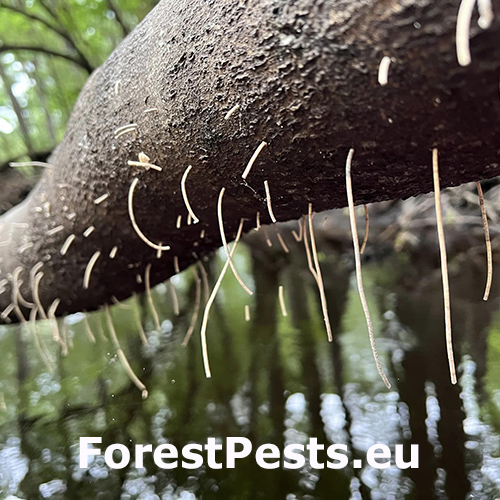
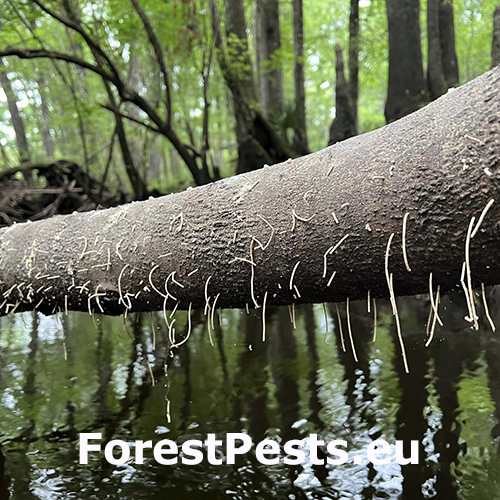
In its native range, this beetle behaves as a secondary pest, but in invaded regions, it is much more aggressive. It is highly polyphagous, attacking many tree species under certain environmental conditions. In the U.S., it damages trees in cities, parks, and nurseries, including fruit, ornamental, and forest trees. Xylosandrus crassiusculus has not been found on conifers and likely does not attack them. Some researchers estimate that it can attack over 100 species of trees, shrubs, and plants from more than 40 families. Hosts in Europe may include maple (Acer), alder (Alnus), birch (Betula), ash (Fraxinus), oak (Quercus), poplar (Populus), willow (Salix), elm (Ulmus), hazel (Corylus), apple (Malus), and grapevine (Vitis), among others. This beetle usually bores into thinner material (up to 8 cm in diameter) but can also attack thicker material (over 30 cm). A key sign of its presence is white sawdust formed into cylindrical shapes, which protrude 1-4 cm (sometimes even more) from the wood.
Ambrosia beetles generally attack stressed or damaged trees, not healthy ones. Infested trees may show signs of weakening, wilting, branch dieback, and even death. Young seedlings can also be attacked, often being girdled at the root collar, leading to rapid death. Infested plum trees (Prunus) often produce excessive liquid around attacked area. In the U.S., Xylosandrus crassiusculus causes significant damage in orchards, particularly after overwatering or late frosts. Urban and park trees, as well as forest nurseries, are also frequently affected.
Symptom
Symptoms resemble those caused by Xylosandrus germanus. Early signs include the female expelling sawdust from boreholes in a cylindrical shape, which can be 1-4 cm high. The exit hole diameter is around 1-1.5 mm. After rain, detection becomes more difficult, as water washes away the debris, leaving only small black holes that are hard to spot. This beetle usually bores into thinner material (up to 8 cm in diameter) but can also attack thicker material (over 30 cm).
Tree Species: Elm, Birch, Beech, Cherry, Eucalyptus, Chestnut, Pear, Ash, Magnolia, Walnut, Poplar, Grape, Willow
Part of a plant- attacked: Tree trunk
Pest significance: Harmful
Pest Category: Insects
Invasive Species: Yes
Present in EU: Yes
Add comment: Xylosandrus crassiusculus
Location map: Xylosandrus crassiusculus
Legend:

Expert verified points

Unverified points
Observed by users on these tree species
Similar damage

Ash Bark Beetle

Shot-hole borer

Bark beetle Hylesinus wachtli orni

