




 Show all photos in album
Insert for comparison
We will identify your pest
Add pictures of this species
Show all photos in album
Insert for comparison
We will identify your pest
Add pictures of this species
Trichoferus campestris
Velvet longhorned beetle
Description
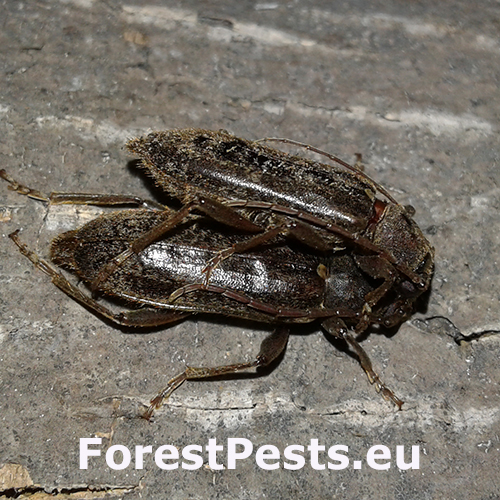
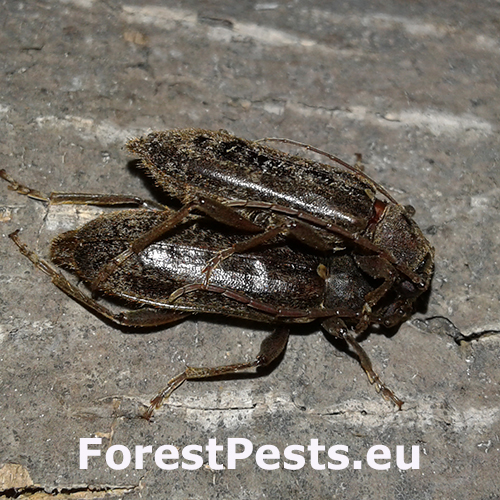
Trichoferus campestris, commonly known as the velvet longhorned beetle, is a polyphagous longhorn beetle native to eastern Asia. It has become an invasive species in Europe and North America, spreading rapidly since the late 20th century. It is now established in many European countries, including Slovakia, Czechia, Germany, Hungary, Italy and etc. The beetle develops in a wide range of deciduous trees such as Juglans, Betula, Populus, Acer, Ulmus and some other. It attacks not only stressed, weakened, or dying trees, but also wooden structures, or products like pallets.
Adults are 11–28 mm long. Adult velvet longhorned beetles emerge during early summer, with large numbers of Trichoferus campestris taking flight between late June and early August. Females deposit their eggs on tree trunks, branches, or the bark of dried logs. Early-stage larvae rely on bark for their development, but as they mature, they burrow into deeper wood layers and no longer depend on the bark for survival. Pupation takes place within the wood during late winter, and new adults emerge in early summer. The complete lifecycle of the velvet longhorned beetle may require up to two years.
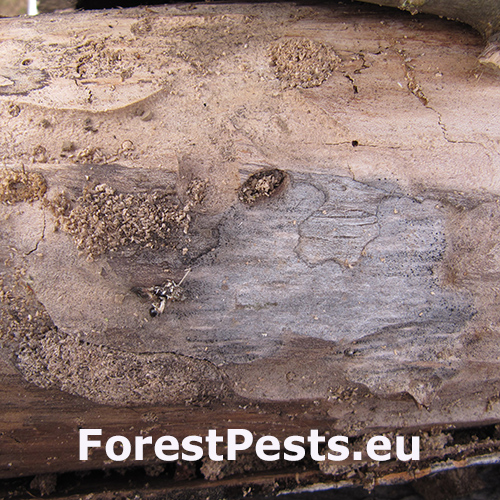
Damage caused by larvae (tunneling under the bark) disrupts nutrient flow, which can lead to branch dieback and eventually tree death. Trichoferus campestris is generally considered a secondary pest. This means it usually infests stressed, weakened, or dying trees rather than healthy ones. However, under certain circumstances, T. campestris can also infest healthy trees, especially when populations are high or in the presence of favorable environmental conditions. This ability to attack both living and recently cut wood makes it a potential threat to forestry and ornamental trees, as well as a concern for timber and wooden products.
Symptom
Infested trees show irregular galleries under the bark, filled with frass and sawdust. Exit holes are oval and approximately 6–8 mm in diameter. Bark may appear cracked or discolored.
Tree Species: Black Locust, Elm, Birch, Honey locust, Pear, Apple Tree, Maple, Mulberry, Poplar, Willow
Part of a plant- attacked: Tree trunk, Branch
Pest significance: Harmful
Pest Category: Insects
Invasive Species: Yes
Present in EU: Yes
Add comment: Trichoferus campestris
Location map: Trichoferus campestris
Legend:

Expert verified points

Unverified points
Observed by users on these tree species
Similar damage

Violet beetle

Longhorn beetle Arhopalus rusticus

Citrus long-horned beetle

