


 Show all photos in album
Insert for comparison
We will identify your pest
Add pictures of this species
Show all photos in album
Insert for comparison
We will identify your pest
Add pictures of this species
Thaumetopoea pinivora
eastern pine processionary moth
Description
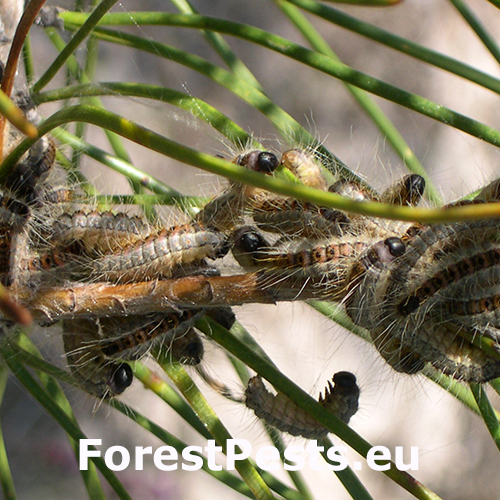
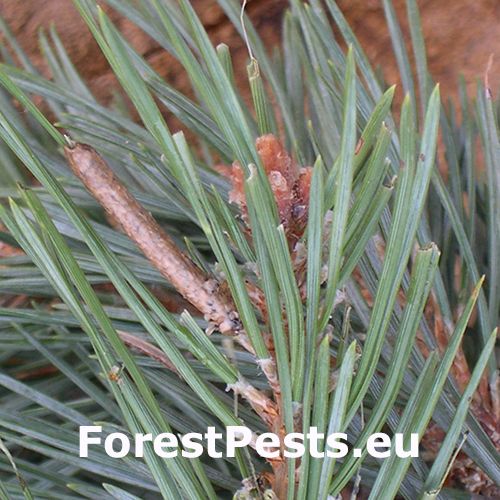
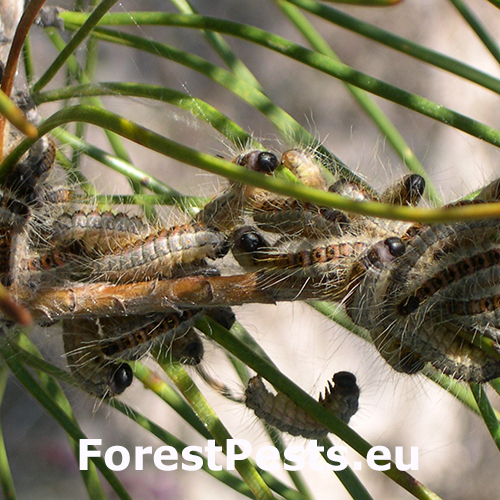
This pine defoliator resembles the pine processionary moth T. pytiocampa. The life cycle of T. pityocampa differs slightly from that of T. pinivora. While T. pinivora has a two-year life cycle, T. pityocampa completes its cycle in one year. Both species are gregarious throughout the larval stage, but T. pityocampa constructs silk nests where the larvae stay when resting (T. pinivora do not build silken nests). Pupation takes place in the soil in summer. Adults are on the wing in autumn. Eggs are laid on pine needles shortly after female emergence and hatch in spring of the following year. The larvae go through five instars and feed until summer when they leave the trees in typical processions to search for suitable sites in the soil for cocoon spinning. Although T. pinivora is common, heavy defoliation occurs very rarely. Present in the northern part of Europe (Germany, Denmark) and Spain, mainly on Pinus sylvestris.
Symptom
Larvae crawling in a typical procession to search for suitable sites in the soil for cocoon spinning.
Tree Species: Pine
Part of a plant- attacked: Leaf / Needle
Pest significance: Very harmful
Pest Category: Insects
Invasive Species: No
Add comment: Thaumetopoea pinivora
Location map: Thaumetopoea pinivora
Legend:

Expert verified points

Unverified points
Observed by users on these tree species
Similar damage

Mottled umber moth

Pine moth

Small spruce sawfly

