




 Show all photos in album
Insert for comparison
We will identify your pest
Add pictures of this species
Show all photos in album
Insert for comparison
We will identify your pest
Add pictures of this species
Rhopalomyzus lonicerae
Honeysuckle-grass aphid
Description
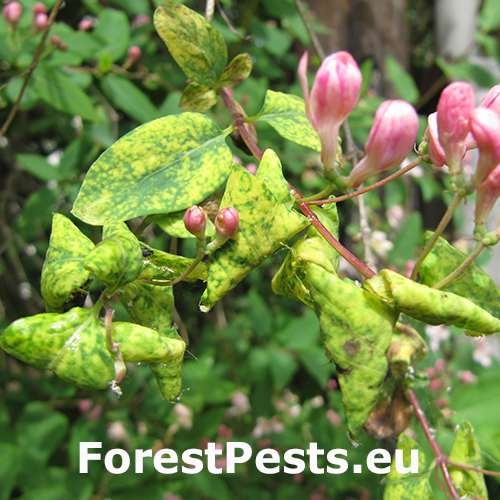
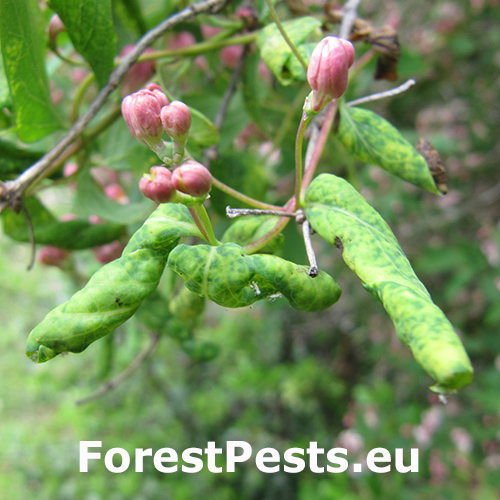
Rhopalomyzus lonicerae, commonly known as the honeysuckle-grass aphid, is a species with a complex life cycle that alternates between honeysuckle (Lonicera spp.) as its primary host and grasses (Poaceae), especially reed canary grass (Phalaris arundinacea), as secondary hosts. The aphid overwinters as eggs on honeysuckle, with hatching occurring in early spring. The fundatrices induce leaf rolling, forming yellow to reddish pseudogalls on the undersides of leaves. The alate offspring migrate to grasses, where they form large colonies of pale cream-colored apterous individuals.
This aphid is distributed throughout Europe, Central Asia, and Siberia. It thrives in both natural and urban environments, often forming dense populations on its hosts. Infestations lead to deformations of honeysuckle leaves, reducing the ornamental value of affected plants. On grasses, the aphids cover the leaves in high numbers, potentially reducing photosynthetic efficiency. While not a primary killer of host plants, repeated infestations can weaken them, making them more susceptible to environmental stress and secondary pathogens.
Symptom
On honeysuckle, leaves are curled downward and discolored. Aphids are present on the underside of the leaves.
Tree Species: Lonicera
Part of a plant- attacked: Leaf / Needle
Pest significance: Harmful
Pest Category: Insects
Invasive Species: No
Present in EU: Yes
Add comment: Rhopalomyzus lonicerae
Location map: Rhopalomyzus lonicerae
Legend:

Expert verified points

Unverified points
Observed by users on these tree species
Similar damage

Barberry aphid

Cotton aphid

Small willow aphid

