




 Show all photos in album
Insert for comparison
We will identify your pest
Add pictures of this species
Show all photos in album
Insert for comparison
We will identify your pest
Add pictures of this species
Phyllocnistis unipunctella
Poplar bent-wing
Description
Phyllocnistis unipunctella, commonly known as the poplar bent-wing, is a small moth from the Gracillariidae family, widely distributed across Europe. With a wingspan of 7–8 mm, this species has shining white forewings with a faint yellowish hue and a distinctive black spot near the apex. It has two generation per a year, adults fly in July and from September onwards, often overwintering under bark and other sheltered areas. The larvae are monophagous leaf miners, feeding exclusively on poplar species, including Populus balsamifera, Populus × canadensis, Populus candicans, Populus deltoides, Populus euphratica, Populus gileadensis, Populus nigra, Populus simonii, Populus suaveolens, Populus trichocarpa etc. Populus alba is not confirmed as a host plant. On this tree species occurs similar species Phyllocnistis xenia. The larvae of Phyllocnistis unipunctella create extensive epidermal mines on the upper leaf surface, producing visible damage that distinguishes this species from similar moths, such as Phyllocnistis xenia, which targets other poplar types.
Symptom
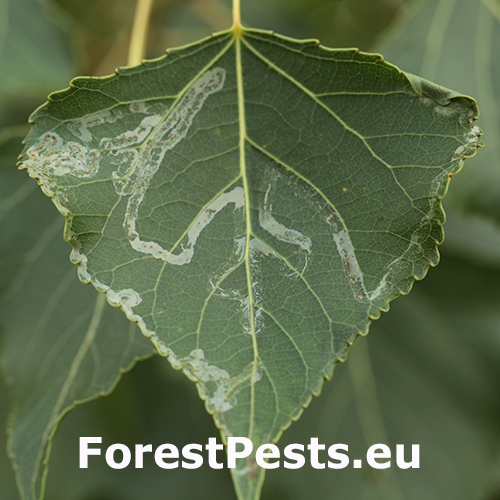
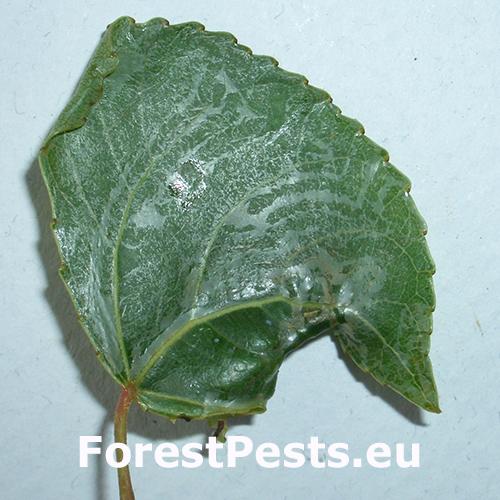
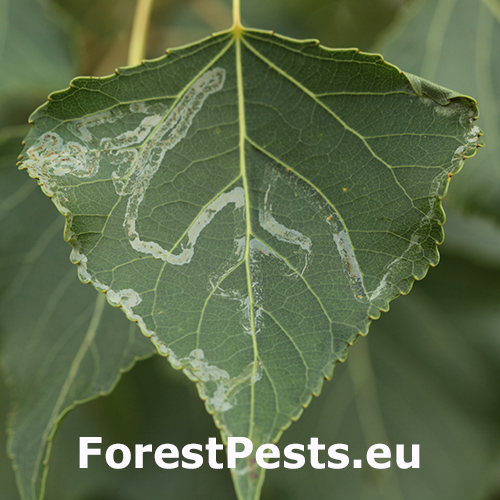
Infestation appears as long, winding mines on poplar leaves, creating a pattern similar to a "snail trail." These mines can reduce the aesthetic value, vitality, and photosynthesis of the trees. Leaf edges may curl as they dry.
Identification of feeding patterns caused by Phyllocnistis unipunctella, Phyllocnistis xenia, and Phyllocnistis labyrinthella can be performed by examining the shape of the mines, their location on the leaf, and the host plants:
- Phyllocnistis unipunctella (syn. Phyllocnistis suffusella):
- Host Trees: Exclusively poplars, especially Populus balsamifera, Populus × canadensis, Populus nigra, and various other poplar species.
- Mine Location: Prefers the upper leaf surface but may also appear on the underside.
- Mine Characteristics: Creates long, winding mines resembling a "snail's trail." Frass is located in a central line, and a slightly expanded area appears at the end of the mine where pupation occurs. The leaf edge may curl slightly.
- Phyllocnistis xenia:
- Host Trees: Prefers Populus alba (white poplar) and Populus tremula. Does not occur on other poplar species.
- Mine Location: Almost always on the underside of the leaf.
- Mine Characteristics: Mines are long and narrow, with a slightly less winding shape than P. unipunctella. They are also narrower. Frass is located in the center of the mine but is less prominent. The leaf edge may curl slightly.
- Phyllocnistis labyrinthella:
- Host Trees: Prefers Populus alba (white poplar) and Populus tremula. Does not occur on other poplar species.
- Mine Location: Mines form on both sides of the leaf.
- Mine Characteristics: Feeding pattern is highly winding, often appearing labyrinth-like, and is broader than mines of other Phyllocnistis species. Frass is centrally located and very prominent. The leaf edge may curl slightly.
Tree Species: Poplar
Part of a plant- attacked: Leaf / Needle
Pest significance: Less harmful
Pest Category: Insects
Invasive Species: No
Present in EU: Yes
Add comment: Phyllocnistis unipunctella
Location map: Phyllocnistis unipunctella
Legend:

Expert verified points

Unverified points
Observed by users on these tree species
Similar damage

Poplar leaf beetle

American grape leafminer

Agrilus ater

