


 Show all photos in album
Insert for comparison
We will identify your pest
Add pictures of this species
Show all photos in album
Insert for comparison
We will identify your pest
Add pictures of this species
Flavescence dorée
Phytoplasma Flavescence dorée
Description
Flavescence dorée is a highly dangerous disease caused by the phytoplasma Candidatus Phytoplasma vitis, an intracellular microorganism related to bacteria but lacking a cell wall. It colonizes the phloem sieve cells of Vitis vinifera, disrupting carbohydrate transport and causing extensive physiological stress to the plant. The pathogen is transmitted by the grapevine leafhopper Scaphoideus titanus, which acquires the phytoplasma while feeding on infected vines and later inoculates healthy plants during sap suction.
The disease leads to progressive weakening of vines, resulting in yellowing or reddening of leaves, insufficient shoot lignification, and shriveled grape clusters. In heavily affected vineyards, the cumulative impact of infection can cause vine dieback and significant yield loss. The severity of outbreaks depends on the abundance of the vector, the health status of vineyards, and environmental conditions.
In Europe, Flavescence dorée is widespread in France, Italy, Switzerland, Slovenia, Croatia, Austria, Hungary..., with new detections reported further north and east. It is considered one of the most damaging phytoplasma diseases of grapevine.
Symptom
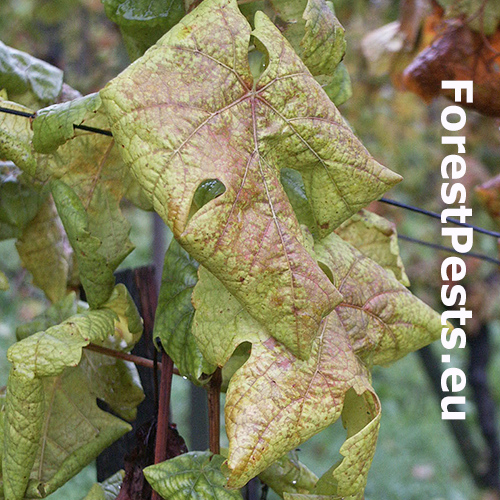
On affected leaves of white cultivars there is golden-yellow discoloration, and on red cultivars reddening; the leaves may curl downward, and shoots remain soft and poorly lignified.
Tree Species: Grape
Part of a plant- attacked: Leaf / Needle, Branch
Pest significance: Very harmful
Pest Category: Bacteria and viruses
Invasive Species: No
Present in EU: Yes
Add comment: Flavescence dorée
Location map: Flavescence dorée
Legend:

Expert verified points

Unverified points
Observed by users on these tree species
Similar damage

Frost

Powdery mildew on grape

Grape erineum mite

