


 Show all photos in album
Insert for comparison
We will identify your pest
Add pictures of this species
Show all photos in album
Insert for comparison
We will identify your pest
Add pictures of this species
Drisina glutinosa
Gall midge Drisina glutinosa
Description
Drisina glutinosa is a gall midge that forms distinctive galls on maples (Acer spp.), particularly on Acer pseudoplatanus and Acer platanoides. It is a monophagous species distributed across Europe. The lifecycle includes one generation per year, with larvae overwintering in the soil and emerging as adults in spring. Galls are formed in May on the undersides of leaves, where larvae develop in a drop of liquid within a depression.
The presence of Drisina glutinosa can reduce the aesthetic value of host trees by causing discolored spots and deformations on leaves. While the damage is mostly superficial, repeated infestations may mildly affect the photosynthetic capacity of the tree.
Symptom
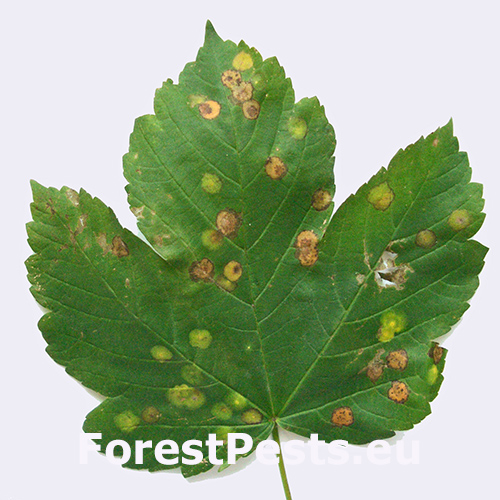
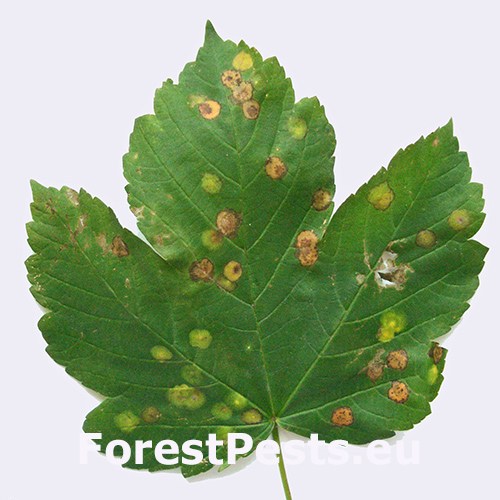
On the undersides of leaves, small depressions house white larvae within a drop of liquid. The surrounding tissue often appears yellowed or discolored. Vacated galls dry and fall out, leaving holes. Infestation looks like yellong round spots on the leaf upper side.
The most significant differences between dmages, caused by two similar species Acericecis campestre and Drisina glutinosa lie in their host plant preferences. Acericecis campestre is primarily associated with Acer campestre (field maple) and sometimes other maples, whereas Drisina glutinosa predominantly infests Acer pseudoplatanus (sycamore maple) and Acer platanoides (Norway maple).
Tree Species: Maple
Part of a plant- attacked: Leaf / Needle
Pest significance: Less harmful
Pest Category: Insects
Invasive Species: No
Present in EU: Yes
Add comment: Drisina glutinosa
Location map: Drisina glutinosa
Legend:

Expert verified points

Unverified points
Observed by users on these tree species
Similar damage

Gall wasp Pediaspis aceris

Gall midge Contarinia acerplicans

Gall midge A. campestre

